eBay vs TCGplayer vs Whatnot: Net-Margin Math for Sellers
A worked-example breakdown of what each channel actually costs you per card, where the margin leaks, and which platform wins for different price points and selling styles.
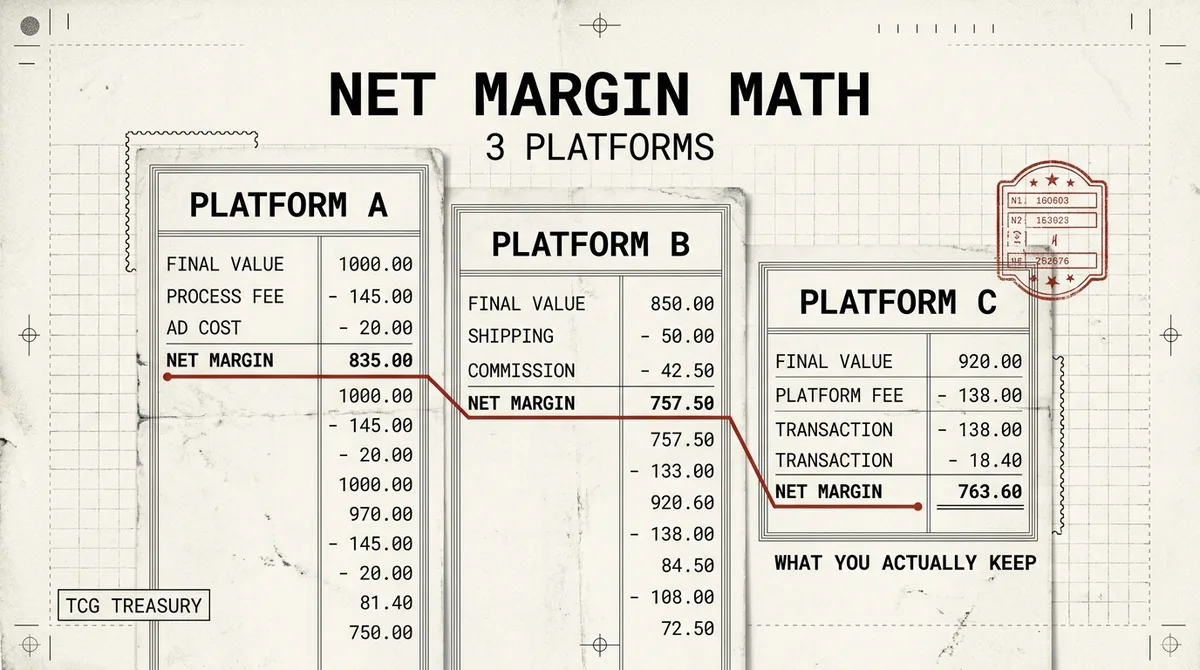
Gross price is a vanity number. The figure that decides whether your card business survives is net margin: what lands in your account after the platform takes its cut, payment processing skims off the top, shipping eats the rest, and a slice of your sales bounce back as returns. The same $40 card can net you $34 on one channel and $28 on another, and at volume that gap is the difference between a business and a hobby.
This post is the money math, not a how-to-sell tutorial. We'll run the same cards across eBay, TCGplayer, and Whatnot with labeled assumptions, show where each channel's fees actually hit, and lay out when each one wins. Fees change constantly and depend on your store tier, category, and promotion settings, so treat every number here as a worked example using stated rates, not a quote. Always confirm current rates on each platform before you price.
The punchline up front: there is no single best channel. eBay wins on search demand and high-ticket singles, TCGplayer wins on commodity TCG singles and buyer trust, and Whatnot wins on velocity and impulse buys during live breaks. The operators who make real money run all three and route each card to wherever it nets the most. If you're listing across channels by hand, the per-listing labor is what quietly kills the margin you just calculated. That's the exact problem CardDealer (carddealer.ai) was built to remove.
- 01Route by price band: cheap commodity singles to high-volume low-friction channels, high-ticket singles to eBay's deep buyer pool
- 02At $40, channel fee differences are under $1 — demand location matters more than the fee table at mid prices
- 03Fixed per-order fees (≈$0.30–$0.49) can be a 10–16% tax on sub-$3 cards before percentage cuts apply
- 04With PSA's cheapest open tier now $79.99, a card must sell for $105–$120 graded just to beat selling it raw
- 05A multi-channel strategy only pencils out if per-listing labor stays near zero — manual cross-posting erases the margin math
The four leaks in every sale
Before comparing channels, name the costs. Every sale on every platform bleeds margin in four places, and most sellers only track the first one.
Platform fee: the headline cut the marketplace takes on the sale total. This is the number everyone quotes and the one that varies most by category, store subscription tier, and whether you opt into promoted listings.
Payment processing: a separate percentage plus a fixed per-order fee, often bundled into the platform fee on managed-payments marketplaces but still real money. The fixed component (commonly around $0.30 to $0.49 per order) hurts most on cheap cards, where a flat fee can be a bigger drag than the percentage.
Shipping and materials: a graded slab in a box costs far more to ship than a raw card in a plain envelope. Whether you or the buyer pays, it comes out of the transaction. Top-loader, team bag, bubble mailer or PWE, label, and a few minutes of labor all count.
Returns and chargebacks: a low single-digit percentage of orders that reverse. You rarely recover the original fees and you eat return shipping. Model this as a haircut on your whole book, not a per-card event. Net margin is gross price minus all four. Track only the first and you'll consistently overestimate what you keep.
Worked example: a $40 raw single
Assumptions (confirm current rates): final price $40, buyer pays nothing extra for shipping (price includes it), your actual ship cost is $5 in postage and materials for a raw card in a bubble mailer, and we ignore returns for this single-card view.
eBay: assume a roughly 13.25% final-value fee on the trading-card category plus about $0.30 per order. That's about $5.30 + $0.30 = $5.60 in fees. After the $5 ship cost, you net about $29.40, or roughly 74% of gross. If you run promoted listings at, say, 2% to 5%, subtract another $0.80 to $2.00.
TCGplayer: assume a commission in the low-to-mid 10% range plus payment processing around 2.5% + $0.30. Call it about 10.25% commission ($4.10) plus roughly $1.30 processing, near $5.40 total. After $5 ship, you net about $29.60. Very close to eBay on a mid-priced single, with the trade-off being TCGplayer's audience is TCG-focused buyers who already trust the platform's condition standards.
Whatnot: assume around 8% plus payment processing in the ballpark of 2.9% + $0.30 on a live or marketplace sale. That's roughly $3.20 + $1.46 = $4.66. After $5 ship, you net about $30.34. On paper the lowest fee load of the three, but Whatnot's economics only work if the live format moves enough volume to justify your show time. A $40 single sold one at a time on a stream is rarely worth it; a tray of them is.
The spread here is only about a dollar. At $40, the channel choice is driven more by where the demand is than by the fee table. The fees diverge much harder at the extremes.
Where the fee structure actually diverges
The mid-priced example looks like a wash. The honest picture shows up at the cheap and expensive ends.
The cheap end (sub-$10 commons and bulk): the fixed per-order fee dominates. A flat $0.30 to $0.49 on a $3 card is a 10% to 16% tax before the percentage cut even applies. This is why TCGplayer's volume-friendly structure and bulk-handling tools tend to win on commodity singles, and why eBay's flat per-order fee makes single cheap cards a loser unless you bundle. Whatnot's live format can move cheap cards in lots and mystery bundles where the per-order fee is spread across many cards in one checkout.
The expensive end ($200+ singles and slabs): the percentage dominates and small rate differences become real dollars. On a $500 card, the gap between an 8% and a 13.25% fee is over $26. Some platforms cap or reduce the fee percentage above certain thresholds, so a high-ticket card can net materially more on whichever channel offers a fee break at that price. This is also where eBay's deep buyer pool and search demand justify a higher fee: a $500 card needs a buyer who is actively searching, and eBay has the most of them.
The takeaway: route by price band. Cheap commodity cards to the lowest-friction high-volume channel, mid cards to wherever demand lives, and high-ticket singles to the channel with the deepest buyer pool and best fee treatment at that threshold.
Comparison at a glance
The table below uses the same stated assumptions as the worked examples. These are illustrative rates for modeling, not quotes. Store subscriptions, category, promoted-listing spend, and seller level all move these numbers, so verify current rates on each platform before you price. The point isn't the exact cents. It's that the ranking flips depending on the card's price and your selling style, which is exactly why a multi-channel operator beats a single-channel one.
The operators who make real money run all three channels and route each card to wherever it nets the most
When each channel wins
eBay wins when the buyer is searching. Its strength is intent-driven demand and the largest pool of card buyers anywhere. High-ticket singles, vintage, sealed product, and anything where a buyer is hunting a specific item belong here despite the higher fee, because the higher fee buys you the audience. The Best Offer mechanic and broad category reach also make it the default for cards that don't fit a TCG-only audience.
TCGplayer wins on TCG commodity singles. For Magic, Pokémon, Yu-Gi-Oh and similar, buyers come to TCGplayer specifically to build decks and complete sets, often buying many cards from many sellers in one cart. Its condition standards and buyer trust reduce friction, and its tooling is built for sellers moving large quantities of singles. If your inventory is deep stacks of playable singles, this is your volume engine.
Whatnot wins on velocity and entertainment. The live auction and show format turns selling into a stream, and impulse buying plus the energy of a live break moves inventory fast, especially repacks, lots, mystery bundles, and breaks. Lower headline fees help, but the real win is throughput: you sell a tray in an hour instead of listing it card by card. It rewards personality and consistency more than the marketplace channels do.
Most serious operators don't choose. They sell high-ticket and search-driven singles on eBay, run TCG commodity volume through TCGplayer, and clear lots and lower-value inventory on Whatnot streams. The constraint isn't strategy, it's labor: maintaining accurate, well-priced listings across three platforms by hand does not scale.
The grading decision inside the margin model
Channel fees are only half the margin story if you're deciding whether to sell a card raw or slab it first. That decision got significantly harder in 2026. PSA paused all four of its Value tiers — Value Bulk ($24.99), Value ($32.99), Value Plus ($49.99), and Value Max ($64.99) — effective June 2, 2026, after its active backlog surged to roughly 10 million cards following a 20% submission spike. The cheapest open PSA tier is now Regular at $79.99 per card with a 40–50 business-day turnaround. Express runs $149 (20–30 days), Super Express $349 (7–10 days), and Walk-Through $599 (5–7 days). PSA is hiring roughly 1,000 additional staff and has invested $200 million in infrastructure, with its own backlog tracker estimating up to four months before Value tiers may reopen.
TAG, which had been positioned as a low-cost AI-grading alternative, closed its Basic, Standard, and Express submission tiers at capacity in May 2026. Only its higher-cost Priority and Walkthrough slots remain open, so TAG is not a viable standard-submission option right now. CGC is still accepting cards but is running slow: Bulk is around 120 working days, Economy around 65, and Standard around 30, with faster lanes available at a premium.
What this means for your margin model: at $79.99 as the realistic floor for a PSA slab, the break-even sale price on a graded card is materially higher than it was even a year ago. A card that would have cleared break-even at $50 graded now needs to clear closer to $105 to $120 graded (accounting for the $79.99 fee, shipping to PSA, return shipping, and the channel fees above) before you're ahead of just selling it raw. Pre-screening cards before submission — using a tool like CardGrade, which returns a grade estimate in about 60 seconds with roughly 92.8% accuracy — is no longer optional overhead. Sending a card that grades an 8 or 9 instead of a 10 at $79.99 a pop is an expensive mistake. Run the numbers through the break-even tool at /tools/grading-calculator before you submit anything.
Making multi-channel actually scalable
The margin math only pays off if the per-listing cost of selling everywhere stays low. Photographing a card, identifying the exact set and variant, pulling a defensible market price, writing the title and description, and publishing it to each channel is the labor that eats the dollar of margin you just fought for. Do that three times per card across three platforms and the spreadsheet stops working.
This is the workflow CardDealer (carddealer.ai) is built to compress. Photograph a card, it identifies the exact card in about 1.4 seconds, prices it on a three-source blend (PriceCharting, Collectr, and TCGplayer) so your number is defensible rather than a guess, and generates a publish-ready listing for eBay, Shopify, and TCGplayer. It's a flat fee and takes 0% of your sales, which matters here specifically: a tool that skims a percentage would become another line in the four-leak model above. A flat fee doesn't scale with your revenue, so it gets cheaper per card the more you sell.
If you're deciding whether a card is even worth listing raw or should go to a grader first, that's a different calculation — and with PSA's cheapest open tier now at $79.99 and CGC's Bulk lane running around 120 working days, the stakes on that decision are higher than they've ever been. Run it through the break-even tool at /tools/grading-calculator, and if you're weighing graders, the comparison at /resources/psa-vs-bgs-vs-cgc-vs-tag breaks down which slab nets the most for your card given current submission realities. For the wider business picture, the pillars at /resources/grading-roi, /resources/selling-cards, and /resources/card-business tie the channel math into the full operation. Price each card right, route it to the channel where it nets the most, and keep the listing labor near zero. That's the whole game.
| Channel | Assumed platform + processing | Est. fees on $40 | Net after $5 ship | Best fit |
|---|---|---|---|---|
| eBay | ~13.25% FVF + ~$0.30/order | ~$5.60 | ~$29.40 (74%) | High-ticket singles, search-driven demand, vintage and sealed |
| TCGplayer | ~10.25% commission + ~2.5% + $0.30 | ~$5.40 | ~$29.60 (74%) | TCG commodity singles, deck-builders, high-volume sellers |
| Whatnot | ~8% + ~2.9% + $0.30 | ~$4.66 | ~$30.34 (76%) | Lots, repacks, breaks, velocity and impulse buys via live shows |
List a card in under a minute.
Photograph a card, AI identifies it in 1.4s, prices it on a transparent 3-source blend (PriceCharting · Collectr · TCGplayer), and writes a publish-ready listing for eBay, Shopify, and TCGplayer.
Which selling platform has the lowest fees for cards?
On headline rate, Whatnot's commission tends to run lowest (often around 8% plus processing in our example), with TCGplayer in the low-to-mid 10s and eBay around 13.25% on trading cards. But lowest fee does not mean highest net. eBay's higher fee buys access to the largest pool of searching buyers, which matters most on high-ticket singles. Always confirm current rates, since store tier, category, and promoted-listing spend change the real number.
Does a flat per-order fee really matter that much?
On cheap cards, yes. A fixed fee around $0.30 to $0.49 per order is a small slice of a $40 card but a 10% to 16% tax on a $3 card before any percentage applies. That's why bulk and commodity singles are punished by per-order fees and do best on channels and formats that bundle many cards into one checkout, like TCGplayer carts or Whatnot lots.
Should I sell the same card on all three channels?
You can list across channels, but route each card to where it nets the most: high-ticket and search-driven singles to eBay, TCG commodity singles to TCGplayer, and lots and lower-value inventory to Whatnot streams. The bottleneck is listing labor across three platforms. A tool like CardDealer that identifies, prices, and generates publish-ready listings for multiple channels is what makes multi-channel selling actually scale.
How do I know my asking price is defensible?
Anchor it to real market data rather than a single source. CardDealer prices on a three-source blend of PriceCharting, Collectr, and TCGplayer, which smooths out the noise of any one feed. Pair that with the break-even tool at /tools/grading-calculator to decide whether a card should sell raw or go to a grader first.
Is it still worth grading cards given the current PSA and TAG situation?
It depends heavily on the card's raw value and expected graded pop. PSA paused all four of its Value tiers effective June 2, 2026 — Value Bulk ($24.99), Value ($32.99), Value Plus ($49.99), and Value Max ($64.99) — after its backlog hit roughly 10 million cards. The cheapest open PSA tier is now Regular at $79.99 per card (40–50 business days). TAG closed its Basic, Standard, and Express tiers at capacity in May 2026, so it is not a standard submission option right now. CGC is still open but slow — Bulk runs around 120 working days, Economy around 65. At $79.99 as the realistic submission floor, a card needs a meaningful grade-driven price premium to justify the cost. Pre-screening with a tool like CardGrade before submitting is the most practical way to avoid paying $79.99 to slab a card that won't grade high enough to clear break-even.

Jamie Budesky — Founder & Operator
Jamie Budesky is the founder of TCG Treasury and a working card dealer who runs a 10,000-card eBay store. He built CardGrade and CardDealer to solve the grading and selling problems he hits on his own bench every week — so the guides here come from operating a real card business, not theory.
Researched with live market data and current pricing sources, then reviewed against a working card dealer's day-to-day operation.