How to Sell Trading Cards at Scale: Channels, Fees, and Going From Hobbyist to Dealer
Selling cards at scale comes down to net margin, not headline price. Here's how the main channels (eBay, TCGplayer, Whatnot, local, shows) compare after fees, when to grade before listing, and the volume tipping point where manual listing breaks and automation pays for itself.
If you have a growing pile of cards and rising sales, the question that actually matters is not "what's it worth" — it's "what do I keep after fees, shipping, and my own time." A $40 card can net you $34 on one channel and $27 on another. Multiply that gap across hundreds of cards a month and the channel mix becomes your real P&L.
This guide is for the operator, not the casual flipper. We'll lay out the main selling channels with an honest net-margin comparison, the grade-before-you-list logic that protects your highest-value cards, and the specific point where listing by hand stops scaling and software earns its keep.
Two things up front. First, every fee number here varies — promo rates, store subscriptions, and category exceptions change constantly, so treat the figures as worked examples with stated assumptions and confirm current rates before you commit. Second, the biggest hidden cost in this business is your own labor. Most sellers price their cards and ignore the clock; the dealers who win track minutes per listing as closely as dollars per sale.
- 01Net margin equals sale price minus fees, shipping, supplies, and the dollar value of your time.
- 02Match each card to the channel where it nets the most, fastest — not the cheapest platform.
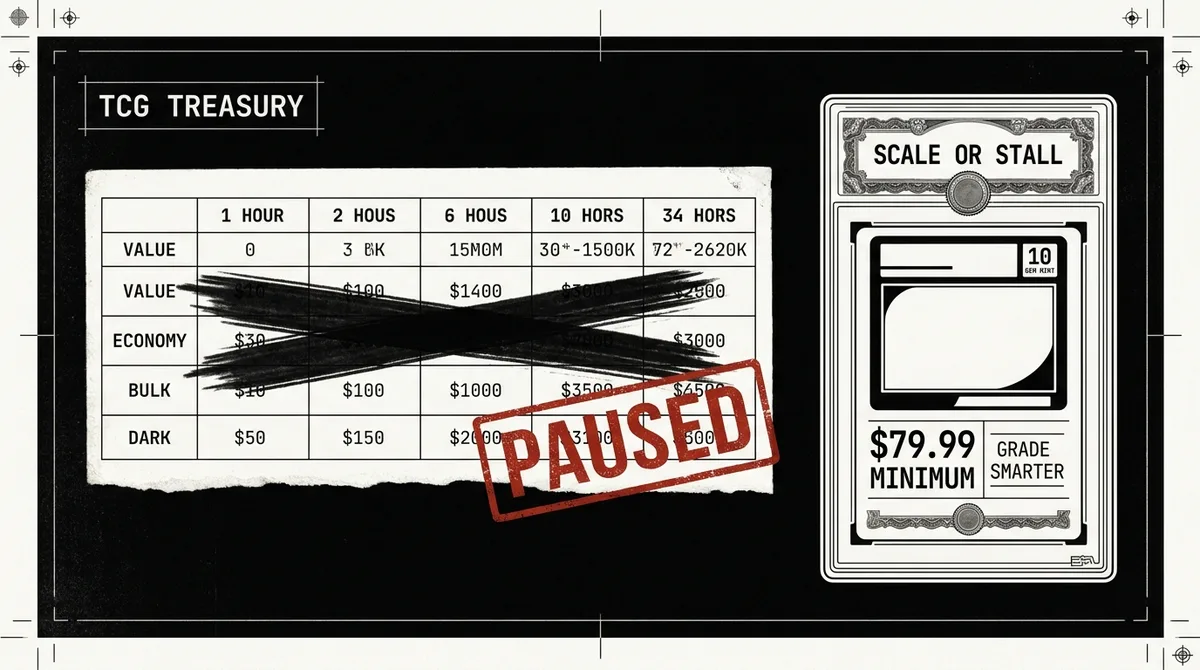
- 03PSA's minimum submission cost is now $79.99; the old sub-$35 bulk tiers are paused indefinitely.
- 04At 200 cards a month, manual listing consumes roughly 20 hours — automation cuts that to 3.5.
- 05Switch from collector to dealer tooling when listing throughput — not sourcing or demand — caps your revenue.
Net margin is the only number that matters
Gross sale price is a vanity metric. What pays your rent is net margin — what lands in your account after marketplace fees, payment processing, shipping, supplies, and your time.
A clean way to think about it: Net = Sale price − marketplace fee − payment processing − shipping − supplies − (minutes spent × your hourly value). Most sellers track the first three and quietly eat the last two. That's a mistake. At volume, a listing that takes you eight minutes instead of two is the difference between a sustainable operation and a second unpaid job.
The other trap is comparing channels on fee percentage alone. A channel with a lower fee but a smaller, slower audience can net you less per card because items sit unsold, get relisted, or eventually sell below market. Liquidity — how fast and how close to market a channel clears your inventory — is part of margin too. The right move is rarely "use the cheapest channel." It's "match each card to the channel where it nets the most, fastest."
The main channels, compared on net margin
Each channel wins on a different axis. eBay has the deepest buyer pool and the most predictable pricing for graded and high-value singles. TCGplayer is purpose-built for TCG singles and bulk, with cart mechanics that move commons efficiently. Whatnot turns selling into live entertainment and can clear large volumes of mid-grade and sealed in a single stream, but the live format and its fee structure mean you're trading margin for speed and reach. Local and LGS sales carry near-zero platform fees but the lowest prices, because the buyer is reselling. Card shows sit in between: a table fee and your weekend, but cash in hand and no shipping.
The table below is a worked example, not a rate card. Fees, promoted-listing rates, and store/seller subscriptions vary by category, country, and current promotions — always confirm the live numbers on each platform before you price. The point isn't the exact percentage; it's the relative shape of the trade-offs.
Read it as: high-value and graded singles lean eBay; TCG singles and bulk lean TCGplayer; fast liquidation of volume leans Whatnot; cash-now-no-shipping leans local and shows. Most serious sellers run two or three of these in parallel rather than betting on one.
Grade before you list — when a slab changes the math
For raw cards above a certain value, the most important pre-listing decision isn't where to sell — it's whether to grade first. A graded card in a strong slab can sell for a large multiple of its raw price, but grading costs money and weeks of turnaround, and a low grade can leave you underwater versus just selling it raw.
That math has shifted sharply in 2026. PSA paused its four Value tiers — Value Bulk ($24.99), Value ($32.99), Value Plus ($49.99), and Value Max ($64.99) — effective June 2, 2026, after its active backlog hit roughly 10 million cards. The cheapest open PSA tier is now Regular at $79.99 per card (40–50 business days), with Express at $149 (20–30 days), Super Express at $349 (7–10 days), and Walk-Through at $599 (5–7 days). TAG, which had been an affordable AI-grading alternative, closed its Basic, Standard, and Express submission tiers at capacity in May 2026; only its higher-cost Priority and Walkthrough slots remain open, so it is not a viable standard-submission option right now. CGC is still accepting cards but is running slow: Bulk at roughly 120 working days, Economy at roughly 65, Standard at roughly 30. The entire industry backed up simultaneously as PSA's $200M infrastructure investment drew a surge of new submissions — a 20% spike that added 1.6 million cards in two weeks alone.
The practical consequence for operators: the floor cost to slab a card is now around $79.99, and turnaround on the affordable tiers that do exist stretches to months. That changes the break-even on every submission. Grading is still worth it when (expected graded value × probability of a strong grade) minus grading and shipping costs clearly beats the raw sale price — but with the minimum fee nearly tripling from what the Value tiers offered, the probability estimate carries far more weight than it used to. Submitting a card that comes back an 8 when you needed a 9 or 10 to justify $79.99 is a real loss, not a rounding error.
This is exactly the gap CardGrade is built to close — and in the current environment it's essential, not optional. Photograph the card and it predicts a PSA, BGS, or CGC grade across 47 inspection points in about 60 seconds, at 92.8% accuracy, so you can triage a stack and only pay to grade the cards likely to clear the bar. For the full break-even math at current fee levels, run your specific card through the grading break-even calculator at /tools/grading-calculator, and if you're deciding which company to submit to, the head-to-head at /resources/psa-vs-bgs-vs-cgc-vs-tag breaks down resale liquidity versus subgrades versus current open tiers. The deeper economics of submission live in the grading-ROI pillar at /resources/grading-roi.
Where manual listing breaks down
At low volume, listing by hand is fine. You photograph a card, look up the price, write a title and description, set a price, and publish. Call it five to eight minutes per card once you include identifying the exact set, edition, and variant.
The problem is that this cost is linear. Two hundred cards a month at six minutes each is twenty hours — half a work week spent on data entry, before a single card sells. And the per-card economics are worst exactly where most volume lives: the $3–$15 commons and mid-value cards where six minutes of labor can exceed the margin on the sale. You end up in a bind — the cheap cards aren't worth listing individually, but bulk-lotting them leaves money on the table.
Three symptoms tell you you've hit the wall: a backlog of unlisted inventory you keep meaning to get to, listings with thin or copy-pasted details because you ran out of time, and pricing that's stale because you set it once and never revisited it. When listing throughput — not sourcing, not demand — is the thing capping your sales, you've outgrown manual.
Liquidity — how fast and how close to market a channel clears your inventory — is part of margin too
The automation tipping point
This is where CardDealer changes the unit economics. Photograph a card and it's identified in about 1.4 seconds, priced on a three-source blend of PriceCharting, Collectr, and TCGplayer data, and turned into a publish-ready listing for eBay, Shopify, or TCGplayer — under a minute per card instead of six-plus. It charges a flat fee and takes 0% of your sales, which matters precisely because it doesn't tax your upside as you scale.
Run the math on the labor line alone. Drop per-card listing time from six minutes to one and that 200-card month goes from twenty hours to roughly three and a half. The freed time is real margin — either more cards listed or fewer hours worked for the same output. And because each listing carries accurate identification and current three-source pricing, you stop bleeding value on the misidentified-variant and stale-price mistakes that quietly erode hand-built listings.
The honest framing: a flat-fee tool pays off above a volume threshold and not below it. If you list a handful of cards a month, keep doing it by hand. If unlisted inventory is piling up and listing is your bottleneck, the per-card cost of automation is a rounding error against the labor and the missed sales. For the full operating model — sourcing, pricing cadence, and channel mix as a business — see the card-business pillar at /resources/card-business, and the channel-by-channel selling playbook at /resources/selling-cards.
Decision tree: collector or dealer?
You don't have to call yourself a dealer to operate like one, but the line determines your tooling and your channels.
You're operating as a collector if you sell occasionally, mostly to fund the next pickup, and a weekend of hand-listing clears your backlog. Stay manual. Grade selectively — only your standout raw cards, and only after checking the break-even at current fee levels (PSA Regular is $79.99 minimum; the old sub-$35 bulk tiers are gone). Sell where the buyers are deepest for that specific card: eBay for graded and high-value singles, TCGplayer for TCG singles, local or shows when you want cash without shipping.
You're operating as a dealer when sourcing volume exceeds what you can list by hand, when listing throughput caps your revenue, and when the same pricing and identification decisions repeat hundreds of times a month. At that point three things change: grading becomes a triage process (with submission costs now starting at $79.99 and cheap tiers either paused or closed, pre-screening with CardGrade is the most reliable way to avoid burning money on cards that won't grade high enough to justify the fee); listing becomes a pipeline (CardDealer for sub-minute, accurately priced listings at a flat fee); and channel choice becomes a portfolio (eBay and TCGplayer for steady margin, Whatnot or shows for fast liquidation of volume). The shift isn't about selling more cards — it's about removing yourself as the bottleneck so the operation scales without scaling your hours.
| Channel | Typical platform + processing fee | Best for | Speed to sell | Net-margin notes |
|---|---|---|---|---|
| eBay | ~13–15% all-in (varies; promoted listings add more) | Graded & high-value singles | Medium–fast | Deepest buyer pool and most predictable graded pricing; promoted-listing rates eat into margin if you opt in |
| TCGplayer | ~10–15% all-in (varies by seller level) | TCG singles & bulk | Medium | Purpose-built cart mechanics move commons efficiently; thin per-card margin makes listing time the deciding cost |
| Whatnot | Commission + processing (varies; live format) | Fast liquidation of volume / sealed | Fast | Trades margin for speed and reach; great for clearing mid-grade volume, weaker for maximizing a single high-end card |
| Local / LGS | ~0% platform fee | Cash now, no shipping | Instant | Lowest prices because the buyer resells; best for offloading bulk or avoiding fees and shipping entirely |
| Card shows | Table fee + your time | Cash, no shipping, networking | Instant–fast | No marketplace cut, but factor table cost and a full weekend; strong for high-value cash deals and sourcing |
Grade it. Then sell it — fast.
Pre-grade with CardGrade so you only submit cards that pay off, then list at volume with CardDealer — under a minute per card, 0% of your sales.
Which channel has the lowest fees for selling cards?
Local sales and your local card shop carry close to zero platform fees, but they also pay the lowest prices because the buyer is reselling. Among online marketplaces, fee percentages vary by category, subscription tier, and current promotions, so the lowest headline fee doesn't always mean the highest net. Compare net margin — price after fees, shipping, supplies, and your time — rather than fee percentage alone, and always confirm current rates on each platform.
Should I grade my cards before selling them?
Grade when the expected graded value times the probability of a strong grade, minus grading and shipping costs, clearly beats the raw sale price. That calculation is more demanding now than it was even a year ago: PSA paused its Value tiers in June 2026, so the cheapest open PSA tier is Regular at $79.99 per card. TAG closed its affordable Basic, Standard, and Express tiers at capacity. CGC is open but slow (Bulk runs roughly 120 working days). With the minimum submission cost roughly tripling from the old bulk-tier floor, accurately estimating the likely grade before you submit is essential. Tools like CardGrade predict a PSA, BGS, or CGC grade from a photo so you can submit only the cards likely to clear the bar, and the calculator at /tools/grading-calculator runs the break-even for your specific card at current fee levels.
At what volume does listing automation make sense?
When listing throughput — not sourcing or demand — is the thing capping your sales. Practical signs are a growing backlog of unlisted inventory, thin or copy-pasted listings because you ran out of time, and stale prices you never revisit. Below a handful of cards a month, hand-listing is fine. Above that, a flat-fee tool like CardDealer that lists in under a minute and takes 0% of sales typically pays for itself on the labor savings alone.
Is Whatnot better than eBay for selling cards at scale?
They serve different goals. eBay has the deepest buyer pool and the most predictable pricing for graded and high-value singles. Whatnot's live-auction format can clear large volumes of mid-grade and sealed product fast, trading some margin for speed and reach. Most high-volume sellers run both — eBay and TCGplayer for steady margin, Whatnot or card shows to liquidate volume quickly — rather than choosing one.
Can I still submit cards to PSA at a low cost in 2026?
Not at the moment. PSA paused its four Value tiers — Value Bulk ($24.99), Value ($32.99), Value Plus ($49.99), and Value Max ($64.99) — effective June 2, 2026, after its active backlog reached roughly 10 million cards. The cheapest open tier is now Regular at $79.99 per card (40–50 business days). PSA is hiring roughly 1,000 additional staff and tracking the backlog publicly, with a stated goal of cutting the queue to 5 million cards before reopening Value tiers — an estimate that could take up to several months. Check psacard.com/info/submission-updates and the backlog tracker at psacard.com/info/backlog-tracker for current status.
- PSA — submission updates and paused Value tiers ↗
- PSA — service-level update, May 2026 ↗
- PSA — backlog tracker ↗
- Sports Collectors Daily — PSA backlog hits 10 million cards ↗
- CGC — turnaround times and submission tiers ↗
- Beckett / BGS — grading and subgrades ↗
- eBay — marketplace selling fees and policies ↗
- TCGplayer — TCG singles and bulk selling ↗
- Whatnot — live auction selling platform ↗
- PriceCharting — trading card price data ↗

Jamie Budesky — Founder & Operator
Jamie Budesky is the founder of TCG Treasury and a working card dealer who runs a 10,000-card eBay store. He built CardGrade and CardDealer to solve the grading and selling problems he hits on his own bench every week — so the guides here come from operating a real card business, not theory.
Researched with live market data and current pricing sources, then reviewed against a working card dealer's day-to-day operation.