Is Grading Worth It as a Business? Break-Even Math, P&L, and When to Slab at Volume
Grading pays when the graded sale price minus the raw price minus the all-in fee clears a real margin — and the grade you actually get is the variable that decides it. Here's the break-even formula, cost-per-card at volume, and a worked P&L with labeled assumptions.
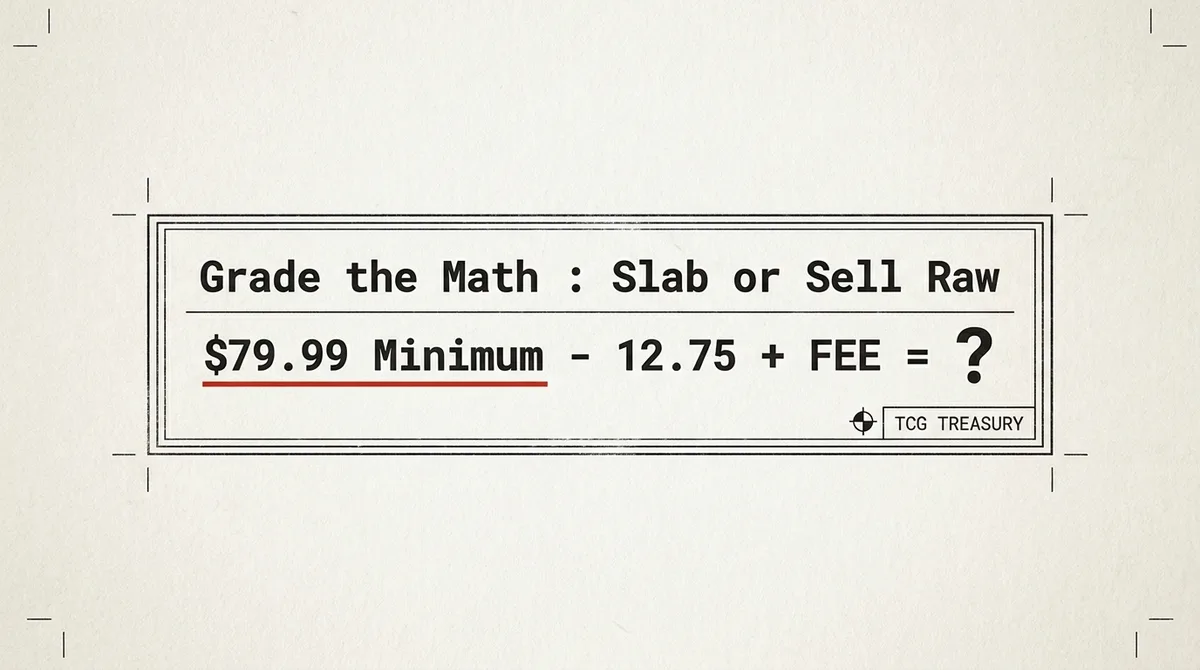
Grading is not a value-add you sprinkle on inventory. It's a bet. You pay a fixed fee and wait weeks, and in exchange you get a number stamped on a slab that the market either rewards or shrugs at. Whether that bet pays is arithmetic, not vibes — and most operators get it wrong because they anchor on the PSA 10 comp and ignore the much likelier outcome of a 9 or an 8.
The honest version of the math is simple. Grading is worth it when the graded sale price, minus the raw price you could sell at today, minus the all-in cost to grade, clears enough margin to justify the capital sitting idle for 40 to 120 business days. The dominant variable in that equation is not the fee — it's which grade the card comes back as. A $50 raw card that grades a 10 might clear $300; the same card at an 8 might clear $70. Same fee, same shipping, wildly different P&L.
This guide gives you the break-even formula, cost-per-card at different submission volumes, the rules for when to slab versus sell raw, and a full worked example with every assumption labeled. One critical context for mid-2026: PSA paused its four Value tiers effective June 2, 2026, after its backlog hit roughly 10 million cards — the cheapest open PSA tier is now Regular at $79.99 per card. That single shift raises the stakes on every submission decision considerably. The single highest-leverage move before you commit a fee is predicting the grade — that's exactly what CardGrade is built for, and why pre-grading changes the unit economics more than any fee tier you'll ever pick.
- 01With PSA's cheapest open tier at $79.99, plan for $90–$100 all-in per submission minimum
- 02A card at 60% odds of a PSA 10 clears ~$39.50 edge; drop to 20% odds and the edge nearly disappears
- 03Pre-grade every candidate before committing a fee — at $79.99 per card, wrong submissions are a meaningful sunk cost
- 04Sell raw when the graded-to-raw spread is thin, grade confidence is shaky, or a hype card may fade before slabs return
- 05Low-value commons and mid-value borderline cards are now clear raw sells at current fee floors
The break-even formula (and the variable that actually moves it)
Strip grading down to one line and it looks like this:
Graded profit = (expected graded sale price × payout odds) − raw sale price − grading fee − shipping both ways − selling fees on the graded sale.
If that number is positive after you've honestly handicapped the odds, you grade. If it's negative or marginal, you sell raw and move the capital. The trap is that four of those terms are roughly fixed and knowable — raw price, fee, shipping, selling fees — while the one that swings the answer by 5x is the grade itself. People build the whole model around shaving the fee when the real spread lives in whether the card comes back a 10 or a 9.
That's why the grade is the dominant variable. On many modern cards, a PSA 10 trades at a large multiple of the PSA 9, while a 9 often barely clears the raw price plus the fee. So your expected value isn't 'the 10 comp minus costs' — it's a probability-weighted blend across the grades you're actually likely to receive, dominated by whether you land the top grade or fall one short. With PSA's cheapest open tier now at $79.99, the margin for error on grade prediction has essentially disappeared. Run the numbers honestly against your real photos before you ship anything; the break-even calculator at /tools/grading-calculator does this weighting for you so you're not eyeballing it.
Why the grade — not the fee — decides the P&L
Consider a card where the PSA 10 sells for $300, the PSA 9 sells for $90, and the raw sells for $60 today. The grading fee is the same in both outcomes. If you grade and hit the 10, you've turned $60 into roughly $200 net after a $79.99 Regular tier fee plus shipping and selling costs. If you grade and get the 9, you've turned $60 into roughly $30 to $40 net after all costs — you spent weeks of waiting and a fee to net almost nothing over selling raw. Hit an 8 and you're meaningfully underwater.
This is the asymmetry every operator has to internalize: the upside is enormous and the downside is real, and the only thing standing between them is a grade you don't control. You can't change the fee enough to matter, but you can change which cards you submit. A card you're 80% confident will hit a 10 is a completely different bet than a card you 'think looks pretty clean.' Centering, edge whitening, and surface flaws that your eye glosses over are exactly what costs you the top grade.
This is the core argument for pre-grading. CardGrade predicts the PSA/BGS/CGC grade from a photo across 47 inspection points in about 60 seconds, at 92.8% accuracy. It catches the off-center borders and the micro edge wear before you've spent a dollar on the submission. You're not guessing at the dominant variable anymore — you're measuring it, and only committing the fee to cards that earn it.
Cost-per-card at different volumes and the mid-2026 tier reality
Your all-in cost per card is the fee plus your share of shipping, insurance, supplies, and labor — and the landscape shifted materially in mid-2026. PSA paused its four Value tiers (Value Bulk at $24.99, Value at $32.99, Value Plus at $49.99, and Value Max at $64.99) effective June 2, 2026, after its active backlog reached approximately 10 million cards — a 20% submission spike added roughly 1.6 million cards in two weeks, approaching the COVID-era peak. The cheapest open PSA tier as of mid-2026 is Regular at $79.99 per card (40–50 business days). Above that: Express at $149 (20–30 business days), Super Express at $349 (7–10 business days), and Walk-Through at $599 (5–7 business days). PSA is hiring roughly 1,000 additional staff and has invested $200 million in infrastructure, but its own backlog tracker estimates it could take up to four months before Value tiers reopen. Check PSA's submission updates and backlog tracker for current status before budgeting.
TAG, which had been an attractive low-cost AI-grading option at around $19 per card, closed its Basic, Standard, and Express submission tiers at capacity in May 2026 — the same demand surge that overwhelmed PSA pushed overflow volume to TAG and CGC. TAG's Priority and Walkthrough slots remain open at higher price points, but TAG is not a viable standard-cost option right now.
CGC is still accepting submissions across all tiers, but turnaround times reflect the industry-wide backlog: Bulk runs approximately 120 working days, Economy approximately 65 working days, and Standard approximately 30 working days. Express and Walkthrough tiers remain faster at a premium.
The practical takeaway for operators: the old economy bulk math at $20 to $25 per card is gone for now. Plan for a minimum of roughly $90 to $100 all-in per PSA submission (headline fee plus two-way shipping, insurance, and supplies), or route to CGC at lower headline fees but with 65 to 120 working days of capital tied up. The tradeoff between cost and time remains, but both ends of it are more expensive than they were a year ago.
When to slab vs. sell raw
A clean decision rule beats a gut feeling. Slab when all three are true: the graded-to-raw spread is large (the top grade sells for a real multiple of raw), you have genuine confidence the card hits a high grade, and the card's value can absorb a multi-week wait without the market moving against you. Sell raw when any of those fails — thin spread, shaky grade confidence, or a hype card whose price is likely to fade before the slab comes back.
With PSA's floor now at $79.99, the threshold for 'worth grading' has moved up meaningfully. Low-value commons and bulk are essentially never worth individual grading at current rates; the fee alone exceeds any realistic lift. Mid-value cards that might have been borderline submissions at a $25 to $35 bulk tier are now clear sells-raw at $79.99. High-value vintage and marquee modern cards still justify grading on liquidity and buyer trust, but confirming the grade band before you pick a fee tier — and a declared value — protects you from spending $79.99 on a card that comes back a 9 when you needed a 10 to clear break-even.
There's also a timing dimension. If a card is riding a spike — a new set, a player's hot streak, a trending character — selling raw now can beat slabbing and missing the window entirely. Grading is a patience play; make sure the card rewards patience, and at current wait times and fees, the patience requirement is higher than ever.
The fee is roughly fixed and knowable — the variable that swings the answer by 5x is the grade itself
Bulk and group-submission economics
Volume is where grading turns from a hobby cost into a business line — but the economics of bulk have changed with the mid-2026 tier suspensions. The per-card fee no longer drops meaningfully at PSA until Value tiers reopen; right now, batching 50 cards into one PSA submission gets you the same $79.99 per card as a single submission, though you still amortize two-way shipping, insurance, and packing labor across the lot. CGC's tiered pricing still rewards volume somewhat, but the 65 to 120 working day wait on economy lanes is a real carrying cost on a large batch.
Bulk has always had a discipline problem, and that problem is now more expensive. When bulk tiers ran $25 to $35 per card, a marginal card that came back a 7 or 8 was a modest drag. At $79.99 a card, every marginal card that comes back a 7 or 8 is a meaningful sunk cost, not a rounding error. The cards that drag a bulk submission's blended ROI down aren't the stars; they're the maybes you talked yourself into.
This is the volume case for systematic pre-grading. Running a stack of candidates through CardGrade before you build the order lets you cut the marginal cards and keep only the ones that clear break-even at the tier you're submitting at. You submit fewer cards, but a higher fraction of them come back at grades that pay — which is what actually lifts the blended margin on the order. At $79.99 per card, the cost of a wrong submission is high enough that pre-grading is not optional; it's the primary cost-control lever available. For the wider sell-side workflow once those slabs come back, see the selling playbook at /resources/selling-cards and the operations economics in /resources/card-business.
Worked P&L example (assumptions labeled)
Here's a single-card example with every assumption stated. Treat the numbers as illustrative — fees, comps, and odds vary, so plug your own into /tools/grading-calculator.
Assumptions: raw sale price today = $60. PSA 10 comp = $300. PSA 9 comp = $90. Grading fee (PSA Regular at $79.99, blended with two-way shipping, insurance, supplies) = $95 all-in. Selling fee on the graded sale = roughly 13% (eBay-style final value fee on a standard card; rates vary by category and value — high-value cards can qualify for reduced rates, so check current eBay rates). Grade odds, from honest pre-grade assessment: 60% chance of a 10, 35% chance of a 9, 5% chance of an 8 (worth ~$60).
Expected graded sale price = (0.60 × $300) + (0.35 × $90) + (0.05 × $60) = $180 + $31.50 + $3 = $214.50. Subtract ~13% selling fees (~$28) → ~$186.50 net of selling fees. Subtract the $95 all-in grading cost → ~$91.50. Compare to selling raw at $60 minus ~13% fees (~$8) → ~$52 net. Grading edge here ≈ $39.50 per card, before counting the 40–50 business days of tied-up capital.
Notice how the same card that showed a much larger grading edge when bulk tiers ran $25 to $35 all-in now shows only a ~$39.50 edge at $95 all-in — the higher fee floor compresses the margin significantly. Now flip one assumption. If your honest odds are 20% for a 10 and 70% for a 9, expected graded price drops to about $126, nets roughly $17 after selling and grading costs — barely above zero, and the 40-plus business day wait almost certainly isn't worth it. Sell raw. That single swing in grade odds is the whole decision, and at current fee levels the break-even grade confidence required is higher than it was a year ago. It's why the cheapest, highest-leverage thing you can do is measure the grade before you commit — pre-grade with CardGrade, then run the result through the calculator.
Use this cluster to decide, then to execute
This guide is the hub of the grading-ROI cluster. Pair it with the break-even calculator at /tools/grading-calculator to run your own cards with your own comps and odds, and with the grader comparison at /resources/psa-vs-bgs-vs-cgc-vs-tag to choose where to submit based on resale liquidity, subgrades, speed, and cost — the choice of grading company changes both the fee and the comp you're solving for. Given that PSA's Value tiers are paused and TAG's core tiers are closed, that comparison is more consequential right now than it has been in years.
The operating principle underneath all of it: grading is a capital-allocation decision, and the grade is the variable you can't afford to guess. With the cheapest realistic PSA submission now running $79.99 per card — and no cheap bulk lane available at any major grader — pre-grading to handicap the odds is essential rather than optional. Weight your expected value honestly, slab only the cards that clear break-even at your tier, and sell the rest raw before the window closes. Do that consistently across a submission and grading stops being a gamble and becomes a margin line you can forecast.
| Approach | Typical headline fee/card | Real all-in cost/card* | Typical wait | Best for |
|---|---|---|---|---|
| PSA Regular (cheapest open PSA tier) | $79.99 | ~$90–$100 | 40–50 business days | Vetted high-confidence cards; current PSA floor |
| PSA Express | $149 | ~$160–$175 | 20–30 business days | Higher-value cards where speed reduces market risk |
| PSA Super Express | $349 | ~$360–$375 | 7–10 business days | High-value cards requiring fast turnaround |
| CGC Economy (open, accepting submissions) | ~$30–$50 | ~$45–$65 | ~65 working days | Volume orders where PSA cost is prohibitive |
| CGC Bulk (open, accepting submissions) | ~$20–$30 | ~$35–$50 | ~120 working days | Maximum cost reduction; long capital tie-up |
| TAG Priority/Walkthrough (core tiers closed) | Higher-cost tiers only | Varies | Varies | Not a standard option while core tiers remain closed |
Predict the grade first.
The grade is the biggest variable in the math. CardGrade predicts your PSA, BGS, and CGC grade from a photo in 60 seconds (92.8% accuracy) — so you only pay to slab the cards that earn it.
What's the simplest break-even rule for grading a card?
Grade when the expected graded sale price (probability-weighted across the grades you're actually likely to get), minus selling fees, minus your all-in grading cost, clears your raw sale price by a margin big enough to justify weeks of tied-up capital. If the edge is thin or the grade is uncertain, sell raw. The grade odds — not the fee — are what usually decide it, so estimate them honestly before you commit. With PSA's cheapest open tier now at $79.99 and no budget bulk lane available at any major grader, the required confidence in hitting a top grade is higher than it has been in years.
How much does it actually cost to grade one card in mid-2026?
PSA paused its four Value tiers effective June 2, 2026, so the cheapest open PSA option is Regular at $79.99 per card (40–50 business days). Add two-way shipping, insurance, and supplies and you're looking at roughly $90 to $100 all-in for a single PSA submission. CGC is still accepting submissions at lower headline fees — Economy runs around $30 to $50 per card but takes approximately 65 working days; Bulk is cheaper but roughly 120 working days. TAG closed its Basic, Standard, and Express tiers at capacity in May 2026; only its higher-cost Priority and Walkthrough slots remain open. Check PSA's submission updates and CGC's current rates before budgeting, as these figures are actively shifting.
Why does the grade matter more than the grading fee?
Because the fee is roughly fixed across outcomes, but the grade can swing the sale price by 3–5x. On many cards a PSA 10 sells for a large multiple of the PSA 9, while the 9 barely clears raw plus the fee. At $79.99 per card as the minimum PSA submission cost, landing a 9 instead of a 10 can mean the difference between a solid profit and a near-breakeven or loss. That's why pre-grading the card is higher leverage than any other variable in the equation.
When should I sell a card raw instead of grading it?
Sell raw when the graded-to-raw spread is thin, when you're not confident the card hits a high grade, or when the card is riding a price spike likely to fade before the slab comes back. With PSA's floor now at $79.99 and no cheap bulk alternative currently available, the bar for 'worth grading' is meaningfully higher than it was — cards that were borderline at a $25 to $35 bulk tier are now clear sells-raw. Low-value and mid-value cards especially need a strong grade-confidence case before committing the fee.
- PSA — submission updates including Value tier pause (June 2, 2026) ↗
- PSA — service-level update May 2026 (backlog context and tier changes) ↗
- PSA — backlog tracker ↗
- Sports Collectors Daily — PSA backlog hits 10 million cards ↗
- CGC — grading services and current turnaround times ↗
- Beckett (BGS) — grading services and subgrade standards ↗
- eBay — seller fees and trading card final value fee structure ↗
- TCGplayer — marketplace pricing and seller fees ↗

Jamie Budesky — Founder & Operator
Jamie Budesky is the founder of TCG Treasury and a working card dealer who runs a 10,000-card eBay store. He built CardGrade and CardDealer to solve the grading and selling problems he hits on his own bench every week — so the guides here come from operating a real card business, not theory.
Researched with live market data and current pricing sources, then reviewed against a working card dealer's day-to-day operation.