Grading Break-Even, Worked: When the Slab Fee Pays (and When It Burns You)
A full P&L walkthrough on one hypothetical card at PSA 10, 9, and 8 — showing exactly where the slab fee earns its keep and where it quietly eats your margin.
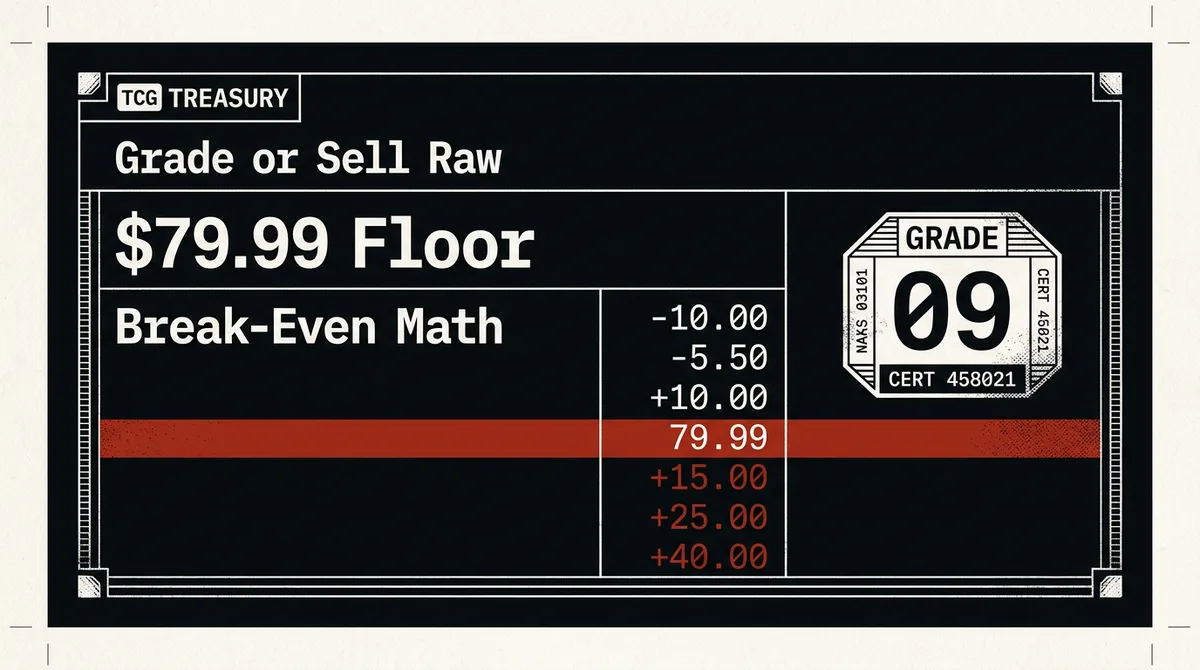
Grading break-even is not a vibe. It is arithmetic, and the answer flips hard depending on one number you do not control: the grade. The same raw card that prints a $400 profit at a 10 can lose you money at an 8 — same fee, same shipping, same card. If you submit on gut feel, you are buying a lottery ticket and calling it a strategy.
This post works one specific hypothetical card all the way through, at three predicted grades, so you can see the moment the P&L crosses from green to red. We are staying in the money lane here — cost-per-card, fees, opportunity cost, expected value. If you want the mechanics of how grading itself works, that lives elsewhere; the point here is when the check clears.
One critical context note before the numbers: as of June 2026, PSA paused all four of its Value tiers — Value Bulk ($24.99), Value ($32.99), Value Plus ($49.99), and Value Max ($64.99) — effective June 2, 2026, after its active backlog hit approximately 10 million cards. The cheapest open PSA option is now Regular at $79.99 per card with a 40–50 business day turnaround. TAG, which had been offering AI-assisted grading around $19 per card, closed its Basic, Standard, and Express tiers at capacity in May 2026; only its higher-cost Priority and Walkthrough slots remain open. The old "$25 bulk" math is gone. Every dollar figure below is a labeled assumption, not a quote — but the floor is materially higher than it was even a year ago. Plug your real current rates into the break-even calculator at /tools/grading-calculator before you act on any of this.
- 01At PSA Regular ($79.99), your all-in cost per card is roughly $85 before marketplace fees.
- 02A PSA 9 on this hypothetical card nets only ~$2 more than selling raw — functionally break-even.
- 03The break-even graded sale price is ~$178; below that, submitting destroys value versus selling raw.
- 04Expected value, not best-case grade, is the correct decision input — honest grade odds change everything.
- 05Pre-screen with a grade prediction tool before submitting; at $79.99 a card, skipping that step is too costly.
The full cost stack of grading one card
Most people anchor on the headline service fee and stop there. That is how you talk yourself into bad submissions. The real cost of putting one card in a slab is a stack, and you have to carry the whole thing before you call anything profit.
For our worked example, here is the per-card cost we will use throughout. Treat each line as a placeholder for your own current numbers:
- Grading service fee: $79.99 per card (PSA Regular — the cheapest open PSA tier as of June 2026, with a 40–50 business day turnaround; PSA paused its four Value tiers on June 2, 2026, after the active backlog reached roughly 10 million cards — a 20% submission spike added 1.6 million cards in two weeks) - Round-trip shipping and insurance, allocated per card: $4 (cheaper per card the more you send in one box) - Supplies — sleeve, toploader, card saver: $1
That is roughly $85 all-in to grade one card at the current floor. On top of that, when you sell the slab you pay the marketplace. We will assume a blended 13% all-in selling cost — final value fee plus payment processing — which is a reasonable stand-in for major card marketplaces and general selling platforms. Fees vary by category and store level, so confirm yours.
Two costs people forget: the $85 is sunk the moment you mail the card, win or lose, and you also gave up the chance to just sell the card raw today. That second one — opportunity cost — is what separates a real break-even from a fake one.
The fee floor matters enormously. When PSA's Value Bulk tier was open at $24.99, a card that graded 9 on a modest raw value could still pencil out. At $79.99 Regular — the only open PSA entry point since June 2, 2026 — the math demands a much stronger grade or a much higher raw value before submission makes sense. Pre-screening is no longer a nice-to-have; it is the only way to avoid paying $85 to manufacture an 8 you did not want.
The card: one hypothetical, three outcomes
Our subject is a modern star rookie parallel that sells raw for about $80. Nothing exotic — the kind of card that sits in the maybe pile for every dealer.
Graded comps, illustrative current-market style numbers:
- PSA 10: sells around $600 - PSA 9: sells around $180 - PSA 8: sells around $95
Notice the shape of that curve. The jump from 9 to 10 is not linear — it is a cliff. The card is worth roughly 3.3x more as a 10 than as a 9, and a 9 is worth less than double an 8. This convex payout is the entire reason grading is a high-variance bet on certain cards: nearly all the value is concentrated in the top grade. Miss the 10 by a hair and the economics collapse.
That is why the grade is the dominant variable in the whole equation. Your fee is fixed. Your shipping is fixed. Your raw value is fixed. The only thing with real leverage over the outcome is which slab number comes back — and a single half-point at the top of the scale swings this card by more than $400 in resale.
When PSA's Value Bulk tier was open at $24.99, even a 9 on this card produced a clear gain. At the current $79.99 Regular floor — the only open PSA entry point since June 2, 2026 — a 9 barely breaks even and an 8 is a significant loss. The grade threshold that justifies submission has moved up sharply.
The P&L, line by line, at each grade
Let me run the actual money for each outcome. The formula is the same every time: graded sale price, minus 13% selling fees, minus the $85 grading stack, compared against what you would have netted just selling it raw ($80 minus 13% = $69.60 net).
Grade 10: $600 sale - 13% fees ($78) = $522 net. Subtract $85 grading = $437. Versus $69.60 selling raw, you are ahead by about $367. This is the dream outcome and it pays well — though notice the 10 payout is about $55 lower than it would have been at PSA's old $24.99 Value Bulk fee, purely because the cost floor moved.
Grade 9: $180 sale - 13% fees ($23.40) = $156.60 net. Subtract $85 = $71.60. Versus $69.60 raw, you netted about $2 more by grading. That is functionally break-even — you tied up the card for 40–50 business days, absorbed all the submission risk, and came out essentially flat. When PSA's Value Bulk tier was open at $24.99, this outcome was a clear $57 win. At $79.99 Regular, it is a wash at best.
Grade 8: $95 sale - 13% fees ($12.35) = $82.65 net. Subtract $85 = -$2.35. Versus $69.60 raw, you are about $72 underwater. You spent money and time to make the card worth far less than if you had left it alone. The slab fee burned you hard.
There is the flip — and it is more severe than it used to be. Same card, same cost structure — and the P&L crosses from a $367 gain to a $72 loss purely on grade. The break-even graded sale price for this card, the price where grading exactly matches selling raw, works out to about $178. Below roughly that resale number, you should not have submitted. At PSA's old $24.99 Value Bulk fee that threshold sat around $114 — the higher fee raised the bar by $64, which eliminates the entire 9-grade profit margin and turns an 8 into a serious loss.
The same raw card that prints a $367 gain at a 10 puts you $72 underwater at an 8 — same fee, same card
Why expected value, not best case, is the number that matters
Here is where most submissions go wrong: people stare at the $437 grade-10 payout and pull the trigger, ignoring how often the 10 actually shows up. You do not get to choose the grade. You get a probability distribution, and you have to price the whole distribution.
Say this card's realistic odds are 20% it comes back a 10, 50% a 9, and 30% an 8. Run the expected value: 0.20 x $522 + 0.50 x $156.60 + 0.30 x $82.65 = $207.54 in expected net resale, minus the $85 stack = about $122. Against the $69.60 you would net selling raw, grading carries roughly $53 of expected uplift on those odds. That is a positive EV, but a much thinner margin than the same calculation produced when PSA's Value Bulk tier was open at $24.99 (which showed roughly $108 of uplift). A single bad assumption about grade distribution now tips this card into negative EV territory.
Now shift the odds. If that same card is really 5% to 10, 35% to 9, and 60% to 8 — a rougher copy — the expected value drops to: 0.05 x $522 + 0.35 x $156.60 + 0.60 x $82.65 = $130.80 in expected net resale, minus $85 = $45.80. Against $69.60 raw, you are $24 in the hole in expectation. The smart move is to sell it raw and keep your $85. The card did not change. Your read on the grade did.
That is the whole game: break-even on a single card is easy arithmetic, but the real decision is probabilistic. You need an honest, calibrated estimate of the grade distribution before you spend a dollar. With PSA Regular at $79.99 and no low-cost fast alternatives currently open, eyeballing it from across the table is exactly how dealers end up with drawers full of 8s and 9s they paid $85 each to create.
Where the grade estimate comes from — and why it has to be honest
The entire P&L pivots on one input you have to supply before submitting: what grade is this card likely to get. Get that read right and break-even math is trivial. Get it wrong — talk yourself into a 10 that is really a 9, or a 9 that is really an 8 — and the cleanest spreadsheet in the world still loses money.
This is the job CardGrade (cardgrade.io) is built for. It photographs the card, runs 47 inspection points, and predicts the PSA/BGS/CGC grade in about 60 seconds at a reported 92.8% accuracy — so the grade you plug into the break-even is a measured estimate, not a guess. For a borderline card like our $80 rookie, knowing whether you are looking at a probable 10, a likely 9, or a coin-flip 8 is the difference between a $367 gain and a $72 loss. At $79.99 per submission, that single read is worth far more than the cost of checking — skipping it is how you donate $85 to the hobby.
The current service landscape makes pre-screening more important than it has ever been. PSA paused all four Value tiers on June 2, 2026, after its active backlog hit approximately 10 million cards — driven by a 20% submission spike that added 1.6 million cards in two weeks, approaching the COVID-era peak of roughly 12 million. PSA now grades about 90,000 cards per day (up from 15,000 in 2021), has invested $200 million in infrastructure, and is hiring roughly 1,000 additional staff in 2026, but its own backlog tracker estimates it could take up to four months before Value tiers reopen. The cheapest open PSA option remains Regular at $79.99 with a 40–50 business day turnaround; Express runs $149 (20–30 days), Super Express $349 (7–10 days), and Walk-Through $599 (5–7 days). TAG closed its Basic, Standard, and Express tiers at capacity in May 2026 — only its higher-cost Priority and Walkthrough slots remain open, making it unavailable as a low-cost alternative right now. CGC is still accepting submissions but runs approximately 120 working days on its Bulk tier, around 65 on Economy, and 30 on Standard. There is no cheap, fast lane right now. Every submission carries real cost and real wait time, which means every borderline card deserves a hard look before it goes in the box.
The workflow that keeps you out of the burn zone: get the predicted grade first, drop it and your real costs into the calculator at /tools/grading-calculator, and only mail the cards where the expected value clears your raw-sale floor with margin to spare. Pre-screen, then submit — not the other way around.
For the bigger picture on grading economics, the parent guide at /resources/grading-roi covers ROI across a whole submission; if you are weighing which service to send to, the head-to-head at /resources/psa-vs-bgs-vs-cgc-vs-tag breaks down cost and turnaround by grader; and if the real goal is moving inventory, /resources/selling-cards and /resources/card-business cover the sell-through side.
| Predicted grade | Graded sale price | Net after 13% fees | Less $85 grading | Uplift vs. selling raw |
|---|---|---|---|---|
| PSA 10 | $600 | $522.00 | $437.00 | +$367.40 |
| PSA 9 | $180 | $156.60 | $71.60 | +$2.00 |
| PSA 8 | $95 | $82.65 | -$2.35 | -$71.95 |
Predict the grade first.
The grade is the biggest variable in the math. CardGrade predicts your PSA, BGS, and CGC grade from a photo in 60 seconds (92.8% accuracy) — so you only pay to slab the cards that earn it.
What grade do I need to break even on grading?
It depends entirely on the card's raw value and your costs, not a universal number. For the $80 raw card in this post, with an $85 all-in grading stack (PSA Regular at $79.99 plus shipping and supplies) and 13% selling fees, the break-even graded sale price is roughly $178 — below that, you would have netted more selling it raw. That threshold sat around $114 when PSA's Value Bulk tier was open at $24.99; the fee increase moved the bar significantly. Run your own card through /tools/grading-calculator with current rates to find its specific break-even.
Why is the grade the most important variable in grading ROI?
Because every other cost is fixed — the service fee, shipping, and your raw value don't change based on outcome — while graded resale value is steeply convex. A top grade can be worth 3x or more than the grade just below it, so a single half-point at the top of the scale can swing a card by hundreds of dollars. With PSA's cheapest open tier now at $79.99 following the June 2, 2026 pause of all four Value tiers, the grade threshold that justifies submission has moved up sharply, making an accurate pre-grade estimate more consequential than ever.
Should I grade based on the best-case grade or the expected grade?
Expected value, always. You don't get to pick the grade you receive — you face a probability distribution across possible grades, so you have to weight each outcome by how likely it is and subtract your costs. At the current $79.99 fee floor, pricing only the best case is how dealers end up paying $85 to manufacture 8s and 9s they didn't want. Estimate the grade distribution honestly first, then decide.
How do I estimate a card's grade before I pay to submit it?
This is what AI pre-grading is for. CardGrade (cardgrade.io) predicts the PSA/BGS/CGC grade from a photo using 47 inspection points in about 60 seconds at a reported 92.8% accuracy. You use that predicted grade as the input to your break-even math, so you only submit the cards where the expected resale clears your costs — instead of guessing by eye and hoping. With PSA's cheapest open tier at $79.99 and no low-cost fast alternatives currently available, skipping this step is an expensive gamble.
Can I use TAG or a cheaper grading service instead of PSA right now?
Not easily. TAG closed its Basic, Standard, and Express submission tiers at capacity in May 2026; only its higher-cost Priority and Walkthrough slots remain open, so it is not a viable low-cost alternative at the moment. CGC is still accepting submissions but runs approximately 120 working days on its Bulk tier and around 65 on Economy. PSA's four Value tiers ($24.99–$64.99) are paused with no firm reopening date after the backlog hit roughly 10 million cards — PSA's own backlog tracker estimates up to four months before those tiers reopen. The realistic floor for slabbing a card today is PSA Regular at $79.99 or a slow CGC lane — factor that into every break-even calculation.
- PSA — submission updates and tier status ↗
- PSA — service-level update, May 2026 ↗
- PSA — backlog tracker ↗
- Sports Collectors Daily — PSA backlog hits 10 million cards ↗
- Beckett (BGS) grading ↗
- CGC Cards — grading services and turnaround times ↗
- eBay — selling fees and marketplace ↗
- TCGplayer — card pricing and marketplace ↗
- PriceCharting — graded card price guide ↗

Jamie Budesky — Founder & Operator
Jamie Budesky is the founder of TCG Treasury and a working card dealer who runs a 10,000-card eBay store. He built CardGrade and CardDealer to solve the grading and selling problems he hits on his own bench every week — so the guides here come from operating a real card business, not theory.
Researched with live market data and current pricing sources, then reviewed against a working card dealer's day-to-day operation.