Group Submissions vs Going Solo: The Real Cost-Per-Card Math
Group submitters cut the per-card grading fee but take a cut and add weeks. Here's the worked math, the break-even point, and the one variable that beats both — now updated for the 2026 backlog reality.
If you grade more than a handful of cards a year, you've hit the fork: submit directly to PSA, BGS, or CGC yourself, or send cards through a group submitter (sometimes called a "group sub" or routed through a breaker). The pitch for going through a group is simple — they pool everyone's cards into a lower-cost tier and pass the savings on to you. The catch is they take a cut or a flat handling fee, and you wait in line behind everyone else's cards.
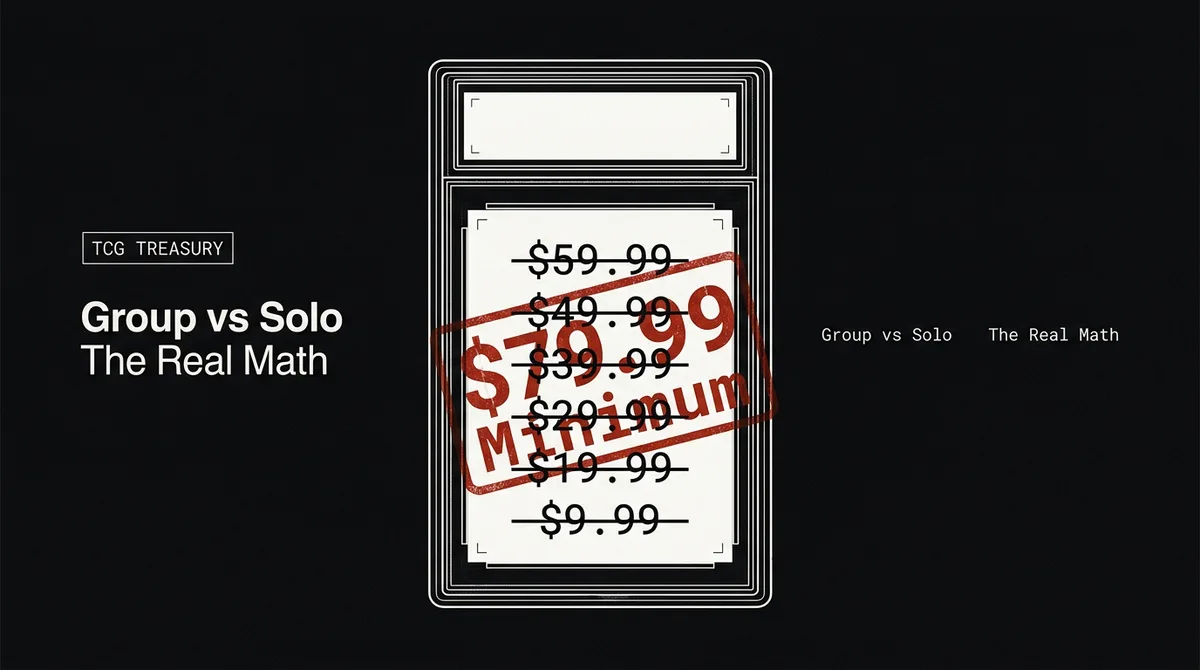
That pitch just got harder to make. As of June 2, 2026, PSA paused all four of its Value tiers — Value Bulk ($24.99), Value ($32.99), Value Plus ($49.99), and Value Max ($64.99) — after its active backlog hit roughly 10 million cards. The cheapest open PSA tier is now Regular at $79.99 per card with a 40–50 business day turnaround. TAG, which had been the low-cost AI-grading alternative, closed its Basic, Standard, and Express tiers at capacity around the same time. CGC is still accepting cards but its Bulk lane runs about 120 working days. The floor on slabbing a card has moved, and it changes the math on both paths.
The honest answer: neither group nor solo is universally cheaper. Going solo wins when your cards are valuable enough to justify a higher service tier and you want speed and control. A group sub wins when you have a stack of cards where pooled shipping and a lower-cost tier (where available) are the dominant savings. The deciding factor underneath both is selection — sending the right cards. At $79.99 minimum per card, a wrong call is no longer a minor inefficiency. This post does the cost-per-card math both ways with labeled assumptions, gives you a decision rule you can apply in thirty seconds, and shows where pre-screening with an AI grade like CardGrade changes the answer before you spend a dollar.
- 01At $79.99 minimum per card, every wrong selection is a guaranteed loss no group discount can recover.
- 02Group subs beat solo only when their lane fee plus handling plus your shipping undercuts solo's all-in cost — verify the actual lane before committing.
- 03Flat-fee groups favor valuable cards; percentage-cut groups favor cheap ones — match the model to your card values.
- 04Solo submission's fixed shipping cost punishes small batches; spreading it across 30+ cards makes per-card overhead nearly disappear.
- 05Pre-screening with an AI grade before packing is now the highest-leverage cost decision, ahead of choosing any submission path.
The three real costs nobody totals up
Most people compare the sticker price of a grading tier and stop there. The actual cost-per-card has three layers, and the group-vs-solo decision turns on all three.
Layer one is the grading fee itself. This varies by grader, declared value, and turnaround tier — check current rates at psacard.com, beckett.com, and cgccards.com before you commit, because tiers and minimums change fast. As of mid-2026, PSA's cheapest open tier is Regular at $79.99 per card (40–50 business days), with Express at $149 (20–30 days), Super Express at $349 (7–10 days), and Walk-Through at $599 (5–7 days). PSA's four Value tiers are paused with no confirmed reopen date — the company estimates up to four months before the backlog clears enough to bring them back. CGC remains open across its lanes, but Bulk runs roughly 120 working days, Economy around 65, and Standard around 30. TAG has closed its Basic, Standard, and Express tiers at capacity; only its Priority and Walkthrough slots are currently available. Beckett continues to accept submissions — verify current tiers and turnaround directly at beckett.com.
Layer two is shipping and insurance, both ways. Solo means you pay outbound shipping, insurance on the declared value, and return shipping. On a small submission this can rival or exceed the grading fee per card. Group subs amortize this across the whole pooled order, which is the quiet reason they can undercut you on small batches.
Layer three is your time and risk. Packing, logging, tracking, and the weeks your capital sits frozen in a card you can't sell. A group sub trades some of that hassle for a middleman fee and less control over timing. None of these three layers shows up on a price page, but together they decide whether you actually came out ahead.
Going solo: the worked example
Assume you're submitting 10 cards directly to PSA on the Regular tier — the cheapest currently open option. Labeled assumptions, all illustrative — confirm live rates yourself before submitting:
Grading fee: $79.99 per card = $799.90. Outbound shipping + insurance: assume $25 for the box. Return shipping + insurance: assume $30 (graded slabs are bulkier and you insure the post-grade value). Supplies (sleeves, semi-rigids, tape): assume $5.
Total: $859.90 for 10 cards = $86 per card, all-in.
Notice the grading fee was $79.99 but your real cost-per-card is $86 — a roughly 7.5% premium driven by shipping. That premium shrinks as the batch grows: spread that same ~$60 of shipping and supplies across 30 cards instead of 10, and the per-card overhead drops from $6 to $2. This is the core dynamic. Solo submission has a fixed shipping cost that punishes small batches and rewards volume. If you're sending two cards, going solo is almost always the worst per-card deal you can get. If you're sending fifty, the shipping overhead nearly disappears and solo's speed and control become pure upside.
One important note: at $79.99 per card, the stakes on every submission are materially higher than they were when bulk tiers existed. A card that comes back an 8 when you needed a 9 or 10 to clear your break-even is a $79.99 lesson. That reality reshapes the selection decision more than it reshapes the group-vs-solo question.
Group submission: the worked example
Now the same 10 cards through a group submitter. Group subs charge in one of two ways: a flat handling fee per card, or a percentage of the final card value. Both are common — read the terms before you ship.
The group-sub value proposition has shifted in 2026. When PSA's Value Bulk tier was open at $24.99, a group sub could pass through a dramatically lower fee than anything you could access solo. With those tiers paused, group hosts who route through PSA are now working from the same $79.99 Regular floor you'd pay yourself — or they're routing through CGC's slower lanes where the per-card fee is lower but the wait is measured in months. Verify which grader and which tier any group host is actually using before you commit.
Flat-fee model, labeled assumptions (CGC Economy lane as the group's route, illustrative): Grading fee passed through: assume $50 per card = $500. Group handling fee: assume $8 per card = $80. Your shipping to the group host only (they handle the bulk leg): assume $15.
Total: $595 for 10 cards = $59.50 per card — cheaper than PSA Regular solo, but with a turnaround measured in months rather than weeks.
Now the percentage model, where it bites. If the group takes 10% of final value instead of a flat fee, a $50 card costs you $5 to the middleman, but a $400 card costs you $40 — far more than a flat handling fee would. Percentage cuts are fine on cheap cards and brutal on good ones. The rule writes itself: flat-fee groups favor your valuable cards, percentage groups favor your cheap ones. And every group sub adds waiting — your cards don't ship until the host fills the bulk order, which can add weeks before the grader's own turnaround clock even starts. On a CGC Bulk lane that already runs 120 working days, that extra queue time is not trivial.
The decision rule
Here's the rule you can apply in thirty seconds at the kitchen table.
Go solo when: you're submitting a larger batch (shipping overhead is already amortized), your cards are valuable enough that a percentage-based group cut would exceed flat solo costs, or you need speed and tracking control. High-value cards almost always belong on a direct submission where you control the declared value, the tier, and the timeline. At current PSA Regular pricing, solo also makes sense when the card's expected post-grade value justifies the $79.99 floor and you want the faster 40–50 business day window rather than a CGC Bulk lane running four to six months.
Use a group sub when: you have a small batch of lower-value cards, the group is routing through a lane with a meaningfully lower per-card fee than you could access solo (verify this — it is not guaranteed in 2026), and you can tolerate the extra weeks or months. For a stack of cards where two-way insured shipping would eat the margin and the group's lane is genuinely cheaper, a flat-fee group can still be the right call.
The break-even is roughly where (group handling fee + group-lane fee + your shipping to host) equals (solo grading fee + solo shipping overhead per card). Rather than eyeball it, run your actual numbers through the break-even calculator at /tools/grading-calculator — plug in your batch size, declared values, and the live fees from your grader of choice, and it tells you which path nets more per card. If you're still deciding which grader to submit to in the first place, the head-to-head at /resources/psa-vs-bgs-vs-cgc-vs-tag breaks down where PSA, BGS, and CGC currently differ on fee structure, turnaround, and which slabs sell best — and notes TAG's current tier availability.
The operators who lose money on grading rarely lose it on the fee structure — they lose it on selection
The variable that beats both: selection
Here's what the fee math hides. Every card you send — solo or group — costs you the fee, the shipping, and weeks of frozen capital whether it comes back a 10 or a 6. The single biggest lever on your cost-per-graded-dollar isn't the submission path. It's not sending the cards that won't grade well enough to justify the cost.
That was true when bulk tiers existed at $24.99. At $79.99 minimum per card, it is not optional math. A card that grades a 9 when you needed a 10 to clear your break-even is a loss no group discount can recover. A card with a soft corner you missed under bad lighting is $79.99 plus shipping plus time, gone. The operators who lose money on grading rarely lose it on the fee structure — they lose it on selection, sending marginal cards into a process that charges them the same regardless of outcome.
This is where a pre-grade pays for itself more clearly than it ever has. CardGrade predicts the PSA, BGS, or CGC grade from a photo in about 60 seconds across 47 inspection points, at 92.8% accuracy. Before you pack a single card, you can sort the stack: clear gem-mint candidates worth a direct high-tier submission, solid 9s that may or may not clear your math at current fee levels, and the cards that aren't worth the fee at all. Run the batch, keep the winners, and your effective cost-per-card drops — not because you negotiated a better fee, but because you stopped paying $79.99 or more to grade cards that were never going to pay you back. Once you've picked the keepers, the group-vs-solo math above tells you the cheapest way to actually slab them.
Putting it together
The group-vs-solo question has a clean answer once you separate the three cost layers and run real numbers. Group subs can still win on small batches by amortizing shipping and routing through a lower-cost lane — but in mid-2026, you need to verify which lane the host is actually using, because PSA's cheap tiers are paused and CGC's slow lanes carry their own waiting-time cost. Solo wins on volume, on valuable cards, and whenever speed and control matter more than shaving dollars off a per-card fee.
Both paths charge you the same whether the card grades well or not, which means the highest-leverage decision happens before you choose a path at all. Pre-screen the stack, send only the cards that clear your break-even at current fee levels, and then pick the cheaper submission route for what's left. With the floor at $79.99 per card and no clear timeline for PSA's Value tiers to reopen, that pre-screening step has moved from good practice to the difference between a profitable operation and an expensive hobby.
For the bigger picture on whether grading earns its keep at all, see the grading ROI pillar at /resources/grading-roi. If your endgame is moving graded cards at the best price, the selling guide at /resources/selling-cards and the broader operations playbook at /resources/card-business cover what happens after the slabs come back. Grade fewer cards, grade the right ones, and the submission-path savings stack on top of a decision you already got right.
Predict the grade first.
The grade is the biggest variable in the math. CardGrade predicts your PSA, BGS, and CGC grade from a photo in 60 seconds (92.8% accuracy) — so you only pay to slab the cards that earn it.
Is a group submission always cheaper than going solo?
No. Group subs can win on small batches by amortizing shipping and routing through a lower-cost lane — but in 2026 you need to verify which lane the host is actually using. PSA's four Value tiers are paused as of June 2, 2026, so any group routing through PSA is working from the same $79.99 Regular floor you'd pay yourself. Groups routing through CGC's slower lanes may offer a lower per-card fee, but the wait can stretch to four to six months. On larger batches, solo shipping overhead amortizes to near nothing per card and you keep full control of timing and declared value.
What happened to PSA's cheap bulk tiers?
PSA paused its four Value tiers — Value Bulk ($24.99), Value ($32.99), Value Plus ($49.99), and Value Max ($64.99) — effective June 2, 2026, after its active backlog reached roughly 10 million cards. The cheapest open PSA tier is now Regular at $79.99 per card with a 40–50 business day turnaround. PSA estimates up to four months before the backlog clears enough to reopen Value tiers. Check psacard.com/info/submission-updates and the backlog tracker at psacard.com/info/backlog-tracker for current status.
What's the hidden cost of group submissions?
Time. Your cards don't ship to the grader until the host fills the bulk order, which can add weeks before the grader's own turnaround clock even starts. On a CGC Bulk lane already running roughly 120 working days, that extra queue time compounds. You also give up control over declared value and tier choice, which matters most on high-value cards where you'd want to set those yourself.
How do I know which cards are worth submitting at all?
Pre-screen before you ship. With the minimum cost to slab a card now at $79.99 or more, a wrong card costs the same fee and shipping whether it grades a 10 or a 6. Running the stack through an AI pre-grade like CardGrade — about 60 seconds per card, 47 inspection points, 92.8% accuracy — lets you keep the cards that clear your break-even and skip the ones that never would, which lowers your effective cost-per-card more than any submission discount.
Flat fee or percentage — which group sub model is better?
It depends on your cards. Flat per-card handling fees favor your valuable cards, since the fee stays the same regardless of value. Percentage-of-value cuts favor cheap cards but get brutal on expensive ones — 10% of a $400 card is $40. Match the model to your batch, verify which grader and tier the host is actually using, and read the full terms before you ship.

Jamie Budesky — Founder & Operator
Jamie Budesky is the founder of TCG Treasury and a working card dealer who runs a 10,000-card eBay store. He built CardGrade and CardDealer to solve the grading and selling problems he hits on his own bench every week — so the guides here come from operating a real card business, not theory.
Researched with live market data and current pricing sources, then reviewed against a working card dealer's day-to-day operation.