The Card Dealer's Grading P&L: Cost-Per-Card at Every Submission Tier
The real cost of grading a card isn't the sticker fee. It's fee plus shipping both ways, insurance, supplies, and your own labor — spread across the batch. Here's how to build the model and decide which cards earn their tier.
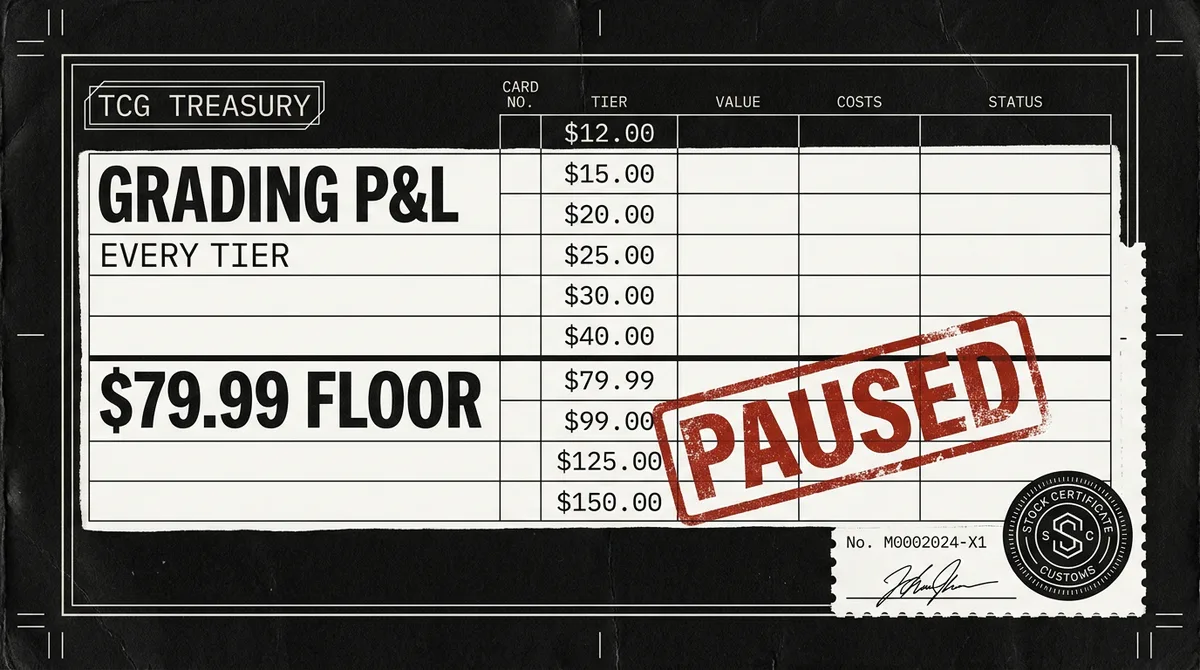
Most dealers calculate grading cost wrong. They look at the grading company's tier fee and stop there. Then the invoice comes back with shipping, the cards sit in working capital for two or three months, and the grade turns out to have cost far more once you count everything that touched it.
The fix isn't to grade less. It's to know your true loaded cost-per-card before the box leaves your hands, so every card you submit clears that number with room to spare. This post builds that model line by line — fee, two-way shipping, insurance, supplies, and labor — and shows how each piece amortizes differently as your batch size grows.
One thing has changed dramatically heading into mid-2026: the cheap bulk tiers that once anchored this math are largely gone. PSA paused all four of its Value tiers — Value Bulk at $24.99, Value at $32.99, Value Plus at $49.99, and Value Max at $64.99 — effective June 2, 2026, after its active backlog hit roughly 10 million cards, driven by a 20% submission spike that added 1.6 million cards in two weeks. The cheapest PSA tier currently accepting submissions is Regular at $79.99 per card (40–50 business days). TAG, which had been the low-cost AI-grading alternative at around $19 per card, closed its Basic, Standard, and Express tiers at capacity in May 2026; only its higher-cost Priority and Walkthrough slots remain open. CGC is still accepting submissions but runs 65 to 120 working days depending on tier. The old bulk-tier math is gone, and that raises the stakes on every submission decision you make.
- 01PSA's cheapest open tier is $79.99/card; loaded cost runs ~$86 at 20-card batches, ~$108 at 4-card batches
- 02Per-shipment costs (shipping, labor, supplies) amortize across every card — never ship a near-empty box
- 03At $79.99 floor, one misgraded card wastes roughly 3–4× more capital than the old $24.99 Value Bulk tier did
- 04Pre-screen every card before submission; a 60-second photo filter is cheaper than a sunk $79.99 fee plus months of dead capital
- 05Build all five cost lines — tier fee, two-way shipping, insurance, supplies, labor — before any box leaves your hands
The five line items in a real grading P&L
A grading submission has more cost lines than the fee. Build the model with all five and you stop getting surprised.
1) Tier fee. The headline number — and in mid-2026 it starts higher than it has in years. PSA's cheapest open tier is Regular at $79.99 per card (40–50 business days); Express runs $149 (20–30 days), Super Express $349 (7–10 days), and Walk-Through $599 (5–7 days). PSA's four Value tiers ($24.99 through $64.99) are paused with no firm reopening date. CGC is still accepting submissions across its tiers, but turnaround times run roughly 30 days at Standard, 65 working days at Economy, and up to 120 working days at Bulk. TAG closed its Basic, Standard, and Express tiers at capacity in May 2026 and currently only accepts Priority and Walkthrough submissions. Fees change, so verify current rates at the source before you budget.
2) Two-way shipping. You ship the cards to the grader, and they ship them back. Both legs cost money, and the return leg often carries insurance based on the total declared value of the batch. Shipping is largely a per-shipment cost, not a per-card cost — which is the single most important structural fact in this whole model.
3) Insurance. Outbound insurance on the raw cards, return insurance on the slabs. For a box of high-value cards this is not trivial, and it scales with declared value, not card count.
4) Supplies. Penny sleeves, semi-rigid card savers (most graders require these), painter's tape, a sturdy box, bubble wrap. Pennies per card individually, but they're real and they're recurring.
5) Labor — yours. The hour you spend pulling cards, sleeving, filling out the online submission form, packing, and driving to the shipper. If your time is worth $30/hour and a submission eats two hours, that's $60 spread across the batch. Dealers who skip this line are lying to themselves about margin.
Why batch size is the whole game
Here's the mechanic that decides your cost-per-card: some costs are per-card and some are per-shipment, and they amortize completely differently.
Per-card costs — the tier fee and most supplies — stay flat no matter how many cards you submit. Grade one card or one hundred, each card still owes its own fee.
Per-shipment costs — outbound shipping, the box, packing materials, the drive to the post office, and a chunk of your labor — get divided across every card in the box. Ship one card and that $15 of shipping-and-handling lands entirely on one card. Ship forty and it's well under a dollar each.
This is why a single-card submission is almost always a bad deal on a mid-value card, and why dealers batch. The math is simple: take your fixed per-shipment costs, divide by the number of cards, and add the per-card costs. As the denominator grows, the per-shipment slice shrinks toward zero and your cost-per-card converges on roughly (tier fee + supplies). Volume doesn't make the fee cheaper — it makes everything around the fee cheaper.
With PSA's cheapest open tier now at $79.99, the fee itself is a much larger share of each card's loaded cost than it was when bulk tiers existed at $24.99 to $64.99. That shifts the math: batch efficiency still matters, but the fee dominates in a way it didn't before. The practical takeaway remains the same — don't ship a four-card box — but the more urgent discipline now is making sure every card in the box is worth the $79.99 floor before it goes in.
A worked example (label your assumptions)
Fees and postage vary by company, declared value, and the day. So instead of quoting numbers as gospel, here's a worked example with every assumption labeled — swap in current rates and your own time value.
Assumptions: a PSA Regular-tier batch of 20 cards at the current $79.99/card rate (40–50 business days). Outbound shipping and insurance: $20 for the box. Return shipping and insurance: $30 for the box (higher because it now carries 20 slabs of declared value). Supplies: $0.50/card. Your labor: 2 hours at $30/hour = $60 for the whole submission.
The math, per card: - Tier fee: $79.99 (per-card, fixed) - Supplies: $0.50 (per-card, fixed) - Outbound shipping: $20 / 20 = $1.00 - Return shipping: $30 / 20 = $1.50 - Labor: $60 / 20 = $3.00
Loaded cost-per-card: about $86.00 — roughly 7.5% on top of the $79.99 sticker fee. The overhead percentage is actually smaller than it was when bulk tiers existed, because the fee is now so large relative to the fixed costs. But the absolute dollar hurdle is dramatically higher. A card now needs to support an $86 cost basis before you see a dollar of margin.
Now run the same submission with only 4 cards. The $79.99 fee and $0.50 supplies don't move. But the $110 of per-shipment costs (outbound + return + labor) now splits four ways: $27.50 per card. Loaded cost jumps to about $108 per card. Same tier, same cards, 26% worse cost basis, purely because the box was too empty. The percentage penalty is smaller than in the old bulk-tier world, but the absolute dollar waste is larger. Label your own numbers and the lesson holds: empty boxes are expensive, and at $79.99 a card, every wasted slot hurts more than it used to.
Cost-per-card by tier (directional, fees vary)
The table below is directional, not a quote — grading fees change and differ by company, so treat it as the shape of the curve, not the price. The pattern that matters: as you climb tiers, the fee dominates and the fixed shipping/labor overhead becomes a smaller share of each card's cost.
The mid-2026 landscape has compressed the lower end of that curve significantly. PSA's four Value tiers — which covered the $24.99 to $64.99 range — are paused with no firm reopening date. PSA has stated it may take up to four months to work the backlog down from its current ~10 million cards to a level where those tiers can reopen, and it is tracking progress publicly via its Backlog Tracker. PSA now grades roughly 90,000 cards per day (up from about 15,000 in 2021), has invested $200 million in infrastructure, and is hiring approximately 1,000 additional staff in 2026 — but the queue is deep. TAG's affordable tiers are similarly closed, with only Priority and Walkthrough accepting new submissions. That means the practical floor for most dealers right now is PSA Regular at $79.99 or a slow CGC lane — and CGC's Bulk tier runs roughly 120 working days, so capital is tied up even longer.
On premium tiers the fee is so large that batch efficiency barely moves the needle — but the card had better be worth it. Use this table to decide tier by card value, then use batch size to optimize whatever tier you land on. The cross-reference for live break-even math is the grading calculator at /tools/grading-calculator, which lets you plug in current fees and your own card values.
Volume doesn't make the fee cheaper — it makes everything around the fee cheaper
Pre-screening: the cheapest dollar in the whole model
Every cost line above assumes the card deserves to be in the box. The most expensive mistake in grading was always paying a full loaded cost-per-card to grade something that comes back a 7 when you needed a 9 to profit. At $79.99 a card, that mistake is roughly three to four times more costly than it was at the old $24.99 Value Bulk rate.
That's a sunk fee, sunk shipping, sunk labor, and two to four months of dead capital, all to confirm a card you shouldn't have submitted. Do that across a batch and your average cost-per-profitable-card balloons, because the duds are subsidized by the winners.
This is the case for pre-grading before you commit. CardGrade (cardgrade.io) predicts the PSA, BGS, CGC, or TAG grade from a photo in about 60 seconds, across 47 inspection points, at 92.8% accuracy. It's not a replacement for the slab — it's a filter that tells you which cards are likely to hit the grade that justifies the tier you're considering. Run the batch through it first, cut the cards that won't clear your break-even, and every card that does go in the box is now carrying its share of the fixed costs instead of wasting them.
At the current fee floor, pre-screening isn't optional discipline — it's the primary lever you have to protect margin. Think of it as raising the floor on what enters the model. The grading P&L only works if the cards you submit earn their tier — pre-screening is how you make sure they do. For the deeper mechanics of what a grade is worth, see the grader comparison at /resources/psa-vs-bgs-vs-cgc-vs-tag, and the full economics in the grading-ROI pillar at /resources/grading-roi.
Turning slabs into sales without re-photographing everything
Cost-per-card doesn't end when the slabs come back — it ends when they sell. The labor of listing graded cards (photographing each slab, identifying it, pricing it against the market, writing the listing) is its own line item that dealers routinely forget when they pencil out grading margin.
If you're moving graded inventory at any volume, that back-end labor compounds the same way the front-end labor did. This is where CardDealer (carddealer.ai) fits the operator workflow: photograph a card, it's identified in about 1.4 seconds, priced on a three-source blend (PriceCharting, Collectr, TCGplayer), and turned into a publish-ready listing for eBay, Shopify, or TCGplayer. It's a flat fee and takes 0% of your sales, so the listing cost stays fixed instead of scaling with your sale price.
The full picture: pre-screen with CardGrade so you only submit cards that earn their tier, batch your submissions to crush the per-shipment overhead, then list the returned slabs efficiently so the back-end labor doesn't eat the margin you fought for up front. For the selling side end to end, see /resources/selling-cards, and for the broader operation, the card-business pillar at /resources/card-business.
| Submission tier | Typical card value it suits | Fee weight per card | Fixed overhead as share of cost | Batch size that makes it work | Pre-screen priority |
|---|---|---|---|---|---|
| Economy / bulk (PSA Value tiers paused; CGC Bulk ~120 working days; TAG core tiers closed) | Low-value commons and modern base | PSA Value tiers unavailable; cheapest open PSA tier is Regular at $79.99; CGC Bulk is slow and ties up capital | Moderate — overhead adds meaningful dollars to an already higher floor than this segment historically carried | Large batches essential; slow turnaround ties up capital significantly at current fee levels | Critical — at $79.99+ per card, a low grade is a large sunk cost with no cheap tier to absorb it |
| Standard (PSA Regular $79.99 / 40–50 business days; CGC Standard ~30 days) | Mid-value singles, solid rookies | Moderate-to-high given the current floor — fee dominates more than it did under old bulk pricing | Lower share — fee now swamps overhead more than it used to at this tier | Medium-to-large batches still help on overhead; don't send a box with fewer than 10–15 cards | High — most common margin trap, now significantly more expensive to get wrong than under old bulk tiers |
| Express (PSA Express $149 / 20–30 days; CGC Express at a premium) | Higher-value, time-sensitive flips | High | Low — fee dominates; overhead is a small fraction | Small batches viable; turnaround speed is the point | Very high — fee is steep and speed is the only reason to use this tier; confirm grade first |
| Premium / high-value (PSA Super Express $349 / 7–10 days; Walk-Through $599 / 5–7 days) | Vintage, key cards, high comps | Very high | Negligible — fee swamps everything else | Even single cards can pencil at the right comp | Critical — confirm grade before paying; no tier forgives a wrong call at this price |
Predict the grade first.
The grade is the biggest variable in the math. CardGrade predicts your PSA, BGS, and CGC grade from a photo in 60 seconds (92.8% accuracy) — so you only pay to slab the cards that earn it.
What's the real cost to grade a single card right now?
More than the tier fee, and the fee floor is higher than it has been in years. PSA paused its four Value tiers — Value Bulk ($24.99), Value ($32.99), Value Plus ($49.99), and Value Max ($64.99) — effective June 2, 2026, after its active backlog hit roughly 10 million cards. The cheapest PSA tier currently accepting submissions is Regular at $79.99 per card (40–50 business days). TAG closed its Basic, Standard, and Express tiers at capacity in May 2026; only Priority and Walkthrough remain open. CGC is open but runs 65 to 120 working days on its slower lanes. On top of whichever fee you pay, add outbound and return shipping, insurance on declared value, supplies, and your own labor. On a single-card submission, the per-shipment costs land entirely on that one card. Batching is what brings the overhead down, but the fee itself is now the dominant cost at every tier.
Does grading more cards at once actually lower the cost per card?
Yes, but only the per-shipment portion. Shipping, the box, packing, and most of your labor are fixed per submission, so they divide across every card in the batch — more cards means each card's slice shrinks. The tier fee and supplies are per-card and don't change with volume. With PSA's cheapest open tier at $79.99, the fee is now such a large share of each card's loaded cost that batch efficiency moves the needle less in percentage terms than it did when bulk tiers existed at $24.99 to $64.99 — but it still matters on the overhead side, and an underfilled box wastes real dollars at these fee levels.
How do I avoid wasting fees on cards that grade low?
Pre-screen before you submit. A pre-grade tool like CardGrade predicts the likely PSA/BGS/CGC/TAG grade from a photo in about 60 seconds, so you can cut cards that won't clear your break-even before they cost you a fee, shipping, and two to four months of tied-up capital. With the cheapest realistic PSA submission now at $79.99 — three times the old Value Bulk rate — a card that comes back a 7 when you needed a 9 is a much larger loss than it was under the old bulk-tier pricing. You can run the break-even math on current fees at /tools/grading-calculator.
Which submission tier should I use given the current backlog situation?
Match the tier to the card's value and your timeline, then use batch size to optimize whatever tier you pick. As of mid-2026, PSA's four Value tiers are paused (cheapest open tier is Regular at $79.99), TAG's Basic/Standard/Express tiers are closed, and CGC's slower lanes run 65 to 120 working days. For time-sensitive flips, PSA Express at $149 or faster tiers may be the only realistic option. For patient capital, CGC Standard at roughly 30 days is open. PSA estimates it may take up to four months to work the backlog down enough to reopen Value tiers, and it is publishing progress via its Backlog Tracker. The grader comparison at /resources/psa-vs-bgs-vs-cgc-vs-tag covers which company fits which goal.
- PSA — submission updates (Value tiers paused June 2, 2026) ↗
- PSA — service-level update May 2026 ↗
- PSA — backlog tracker ↗
- Sports Collectors Daily — PSA backlog hits 10 million cards ↗
- CGC Cards — grading services and turnaround times ↗
- Beckett (BGS) — card grading ↗
- eBay — graded card marketplace ↗
- TCGplayer — pricing and selling ↗

Jamie Budesky — Founder & Operator
Jamie Budesky is the founder of TCG Treasury and a working card dealer who runs a 10,000-card eBay store. He built CardGrade and CardDealer to solve the grading and selling problems he hits on his own bench every week — so the guides here come from operating a real card business, not theory.
Researched with live market data and current pricing sources, then reviewed against a working card dealer's day-to-day operation.