How to Run a Card Business: From Collection to Cash Flow
A plain-English operator's guide to turning a card collection into a business — the end-to-end workflow, the tool stack, cost-per-card math, cash-flow discipline, and the bottlenecks that cap your growth.
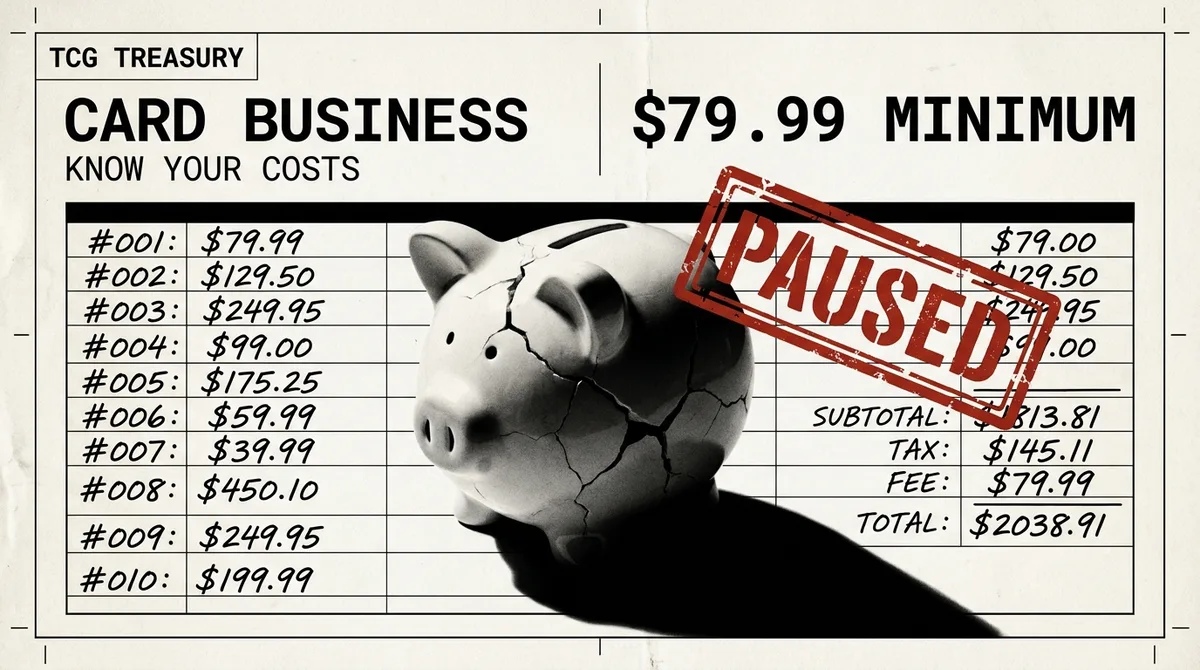
A card business is not a bigger version of collecting. It's an operation: cards come in at a cost, move through a workflow, and go out at a price — and the gap between those two numbers, minus every fee and hour in between, is your margin. Most people who "go pro" lose money for a year because they optimize the fun parts (sourcing, the chase) and ignore the boring parts (cost-per-card, channel fees, cash tied up in inventory).
This guide walks the full loop — sourcing, the grading decision, pricing, listing, fulfillment, and reinvestment — from the perspective of P&L, not hobby. The two places where the math breaks down for most operators are the same two places where the manual work piles up: deciding what to grade, and getting inventory listed. Those are the two automation points worth paying for.
We'll keep the numbers honest. Fees and prices change constantly — and as of mid-2026, the grading landscape has shifted dramatically — so treat every dollar figure here as a worked example with stated assumptions, not a quote. Check current rates before you commit capital.
- 01Know your fully-loaded cost per card: acquisition, grading, labor, fees, and shipping — not just buy price
- 02With PSA's cheapest open tier at $79.99, pre-grade every card before submitting or risk turning profit into loss
- 03Track sell-through rate and days-to-cash; a card in a grading queue for 2–3 months is capital you cannot deploy
- 04A boring $20 card you can list in two minutes often beats a $200 trophy card that sits for six months
- 05Listing labor is a real cost: ten minutes per card at $20/hour adds $3.30 per listing before a single fee
The loop: what a card business actually is
Strip away the hobby and a card operation is a six-stage loop that repeats: source → grade decision → price → list → fulfill → reinvest. Cash enters at sourcing and doesn't come back until a card sells and clears — sometimes weeks or months later. Everything in between is work and waiting.
The discipline is treating each stage as a cost center with a number attached. Sourcing has an acquisition cost per card. The grading decision has a fee and a turnaround time. Listing has a labor cost (how long it takes you to identify, price, photograph, and publish one card). Selling has a channel fee. Fulfillment has shipping, supplies, and time. Reinvestment is the discipline of not spending profit on cards you 'love' that won't move.
The operators who scale are the ones who know their fully-loaded cost per card — acquisition plus grading plus labor plus fees plus shipping — and refuse to buy inventory that can't clear that number with margin to spare. The hobbyists who fail are the ones who only track the buy price and call the rest 'overhead.'
Stage 1 — Sourcing: buy the spread, not the card
You make money when you buy, not when you sell. Sourcing is where margin is created or destroyed, and the unit you're really buying is the spread — the gap between your all-in cost and the realistic net you'll clear after fees.
Channels each have a personality. Local pickups and collection buyouts give you the best spread but the most sorting work and the most junk per good card. Online marketplaces are efficient but competitive, so the spread is thin. Card shows and group breaks sit in between. Whatnot and live auctions can be a sourcing channel as much as a selling one — you can buy lots cheap when attention is elsewhere.
The trap is volume without a thesis. A 5,000-card collection bought for a flat price feels like a deal until you realize 4,800 of those cards are bulk worth pennies, and the labor to identify and list the 200 good ones eats the margin. Buy with an exit in mind: which channel sells this, at what price, minus what fees. If you can't answer that at the buy, you're speculating, not sourcing.
Stage 2 — The grading decision: the highest-leverage call you make
Grading is the single decision that most often turns a profitable card into a loss — and as of mid-2026, the stakes are higher than they've been in years. PSA paused its four Value tiers — Value Bulk ($24.99), Value ($32.99), Value Plus ($49.99), and Value Max ($64.99) — effective June 2, 2026, after its active backlog surged to roughly 10 million cards. A 20% submission spike added approximately 1.6 million cards in two weeks, pushing the queue close to the COVID-era peak of around 12 million. The cheapest open PSA tier is now Regular at $79.99 per card with a 40–50 business day turnaround; Express runs $149 (20–30 days), Super Express $349 (7–10 days), and Walk-Through $599 (5–7 days). PSA is investing heavily to work through the queue — grading roughly 90,000 cards per day, hiring around 1,000 additional staff in 2026, committing $200 million in infrastructure, and publishing a monthly Backlog Tracker — but estimates suggest it could be up to four months before the Value tiers reopen.
TAG, which had been the low-cost AI-grading option at around $19 per card, closed its Basic, Standard, and Express submission tiers at capacity in May 2026 — only its higher-cost Priority and Walkthrough slots remain open, so it is not a viable standard submission path right now. CGC is still accepting submissions, but its Bulk lane runs approximately 120 working days and Economy around 65. There is no cheap, fast path to a slab right now.
The math is unforgiving at these fee levels. Assume a raw card worth around $40 and a minimum grading cost of roughly $95 all-in at PSA Regular (fee plus two-way shipping). A Gem Mint 10 might 3x the raw value; a 9 might barely beat raw; an 8 often sells at or below what the raw card would have fetched, now with nearly $100 sunk into it. At the old Value tier prices, a borderline submission was an expensive mistake. At $79.99 and up, it can be a catastrophic one.
This is exactly where pre-grading earns its keep — and why it has moved from a nice-to-have to an operational necessity. CardGrade predicts the PSA, BGS, or CGC grade from a photo in about 60 seconds across 47 inspection points, at 92.8% accuracy — so you screen the submission before you pay the fee, not after. The workflow is simple: scan the card, see the predicted grade, and only submit cards where the predicted grade clears your break-even multiplier at the current fee floor. Run the actual numbers on the break-even calculator at /tools/grading-calculator, and if you're deciding between graders, the trade-offs are laid out at /resources/psa-vs-bgs-vs-cgc-vs-tag. The deeper P&L of grading at volume lives in the grading-ROI pillar at /resources/grading-roi.
Stage 3 — Pricing with transparent comps
Pricing is where amateurs leave money on the table in both directions: they lowball good cards to move them fast, and they overprice junk that then sits and ties up cash. The fix is comps — real recent sold prices, not asking prices, and not what one optimistic listing claims.
The honest method is a blend. No single source is gospel: marketplace sold listings reflect what buyers actually paid, price guides smooth out the noise, and aggregators catch cards the others miss. A price built from several sources is harder to argue with and less likely to be skewed by one outlier sale. Pull a recent window — the last 30 to 90 days — because card prices move, and a comp from last year's peak is fiction today.
At one or two cards a day you can do this by hand. At fifty, you can't — and this is the second place the operation breaks. CardDealer identifies a card in about 1.4 seconds and prices it on a three-source blend (PriceCharting, Collectr, and TCGplayer), so every card in your inventory carries a defensible, comp-backed price without you opening five tabs per card. That consistency matters as much as the number: priced-the-same-way inventory is inventory you can trust when you reprice in bulk or report on margins.
The operators who scale know their fully-loaded cost per card and refuse to buy inventory that can't clear that number with margin to spare
Stage 4 — Listing and fulfillment: where time becomes the bottleneck
Once you're past a few cards a day, your constraint stops being money and becomes minutes. Every card has to be identified, priced, described, photographed, and published to wherever it sells — and if that takes ten minutes a card, you physically cannot list a 500-card buy without it becoming a second job.
This is the cost most new operators never put on the books: their own labor. If listing a card takes ten minutes and your time is worth even $20/hour, that's roughly $3.30 of labor baked into every listing before it sells. On a $15 card, that labor plus channel fees plus shipping can erase the margin entirely. The way you win here is throughput — getting cost-per-listing down so cheap cards are still worth listing.
That's the core of CardDealer's pitch: photograph a card, get it identified and priced, and out comes a publish-ready listing for eBay, Shopify, or TCGplayer. It runs on a flat fee and takes 0% of your sales — which matters because percentage-of-sale tools punish you precisely as you scale, while a flat fee gets cheaper per card the more you move. The channel-by-channel net-margin math (eBay vs TCGplayer vs Whatnot, and how fees and audiences differ) is broken down in the selling pillar at /resources/selling-cards.
Inventory and cash-flow discipline
A card business can be profitable on paper and still die of thirst, because profit and cash are not the same thing. Every dollar in unsold inventory is a dollar you can't use to source the next deal. Scale the inventory faster than it sells and you'll be 'rich' in cardboard and broke in the bank.
Track two numbers religiously. First, sell-through: what fraction of what you list actually sells in a given window. Slow sell-through means cash is trapped; it's the signal to reprice, change channels, or stop buying that category. Second, days-to-cash: how long from buying a card to having spendable money back, including grading queues and marketplace payout holds. With PSA's Regular tier running 40–50 business days and CGC's Economy lane at roughly 65 working days, a card submitted today might not come back for two to three months — and then it still has to sell. That is a long, capital-intensive loan you are making to yourself, which is exactly why the submission filter matters so much right now.
The operator's habit is reinvestment discipline: separate the float (the cash that must keep cycling to source inventory) from genuine profit, and don't let a hot streak talk you into buying cards that won't clear your cost structure. A boring, fast-moving $20 card you can list in two minutes often beats a sexy $200 card that sits for six months. The full operating playbook — bookkeeping, structure, and treating it like a business — is in the card-business cluster at /resources/card-business.
Common mistakes and the bottlenecks that cap you
The recurring mistakes are predictable. Grading on emotion instead of expected value — submitting cards because they're beloved, not because the predicted grade clears break-even at the current fee floor. Pricing off asking prices instead of sold comps. Ignoring fully-loaded cost, especially your own labor. Buying faster than you can list, so inventory and cash both stall. And chasing high-dollar 'trophy' cards when boring volume pays the bills more reliably.
In the current grading environment, one additional mistake has become especially costly: submitting borderline cards without pre-grading them first. PSA's four Value tiers — which ranged from $24.99 to $64.99 — are paused as of June 2, 2026. TAG's affordable Basic, Standard, and Express tiers are closed at capacity. The cheapest open PSA tier is $79.99 and CGC's faster lanes carry a significant premium over its slow Bulk and Economy options. A card that grades an 8 instead of the expected 10 doesn't just disappoint — it can turn a profitable card into a meaningful loss. The math that was merely unfavorable at the old Value tier prices is punishing at $79.99 and up.
The bottlenecks that actually cap a card business are rarely capital — they're throughput. The grading decision is a bottleneck because doing it by gut is slow and wrong; pre-grading removes the guesswork and, at today's fee levels, pays for itself on the first avoided bad submission. Listing is a bottleneck because manual identification, pricing, and publishing don't scale with a single pair of hands; automating it is what lets one person run inventory that used to need a team.
That's why the two paid automation points in this whole loop are the grading decision (CardGrade) and the listing pipeline (CardDealer). Everything else — sourcing instinct, channel choice, cash discipline — is judgment you build over time. The two spots where software buys you genuine leverage are the two spots where manual work and bad math quietly bleed your margin. Fix those, and the operation scales with you instead of breaking under you.
| Cost line | Raw card sold | Graded card sold |
|---|---|---|
| Acquisition cost | $10 | $10 |
| Grading (PSA Regular fee + two-way shipping, current floor) | — | ~$95 |
| Listing labor (~10 min @ $20/hr) | ~$3.30 | ~$3.30 |
| Channel + payment fees (~13%, varies) | ~$5 | ~$20 |
| Shipping + supplies | ~$5 | ~$5 |
| Assumed sale price | $40 | $150 (predicted Gem 10) |
| Net before your time | ~$16.70 | ~$16.70 |
List a card in under a minute.
Photograph a card, AI identifies it in 1.4s, prices it on a transparent 3-source blend (PriceCharting · Collectr · TCGplayer), and writes a publish-ready listing for eBay, Shopify, and TCGplayer.
How much money do I need to start a card business?
Less than the capital you need is the discipline to manage it. The real constraint is float — cash that must keep cycling to source the next deal — plus a buffer for grading queues and marketplace payout holds that delay when money comes back. With PSA's cheapest open tier currently at $79.99 per card (40–50 business days) and CGC's Economy lane running roughly 65 working days, grading queues are tying up capital for longer than they did even a year ago. Start with an amount you can afford to have tied up in unsold inventory for two to four months, and grow the float only as fast as your sell-through proves you can move product.
Should I grade my cards before selling them?
Only when the predicted grade clears your break-even multiplier — and that bar is significantly higher now than it was before mid-2026. PSA paused all four of its Value tiers (which ranged from $24.99 to $64.99) effective June 2, 2026; the cheapest open PSA tier is now Regular at $79.99 per card (40–50 business days). TAG closed its Basic, Standard, and Express submission tiers at capacity in May 2026, leaving only its higher-cost Priority and Walkthrough slots open. CGC is accepting cards but its Bulk lane runs around 120 working days and Economy around 65. A 9 or 8 on a mid-value card at these fee levels will almost certainly net you less than selling it raw. Pre-grade first to screen the submission: CardGrade predicts the grade from a photo at 92.8% accuracy, and the break-even calculator at /tools/grading-calculator turns that prediction into a yes-or-no decision.
What's the biggest hidden cost in running a card business?
Your own labor. If identifying, pricing, photographing, and listing a card takes ten minutes, that's a few dollars of cost baked into every listing before channel fees and shipping. On low-dollar cards that labor can erase the margin entirely, which is why throughput — getting cost-per-listing down — is what determines whether you can profitably list a large buy or get buried by it. Grading fees are a close second: with PSA's cheapest open tier at $79.99 and no inexpensive fast alternatives currently available, a single bad grading call on a mid-value card can wipe out the profit from several good ones.
How do I price cards I'm not sure about?
Use recent sold comps from several sources, not asking prices and not a single guide. A blend of marketplace solds, a price guide, and an aggregator is harder to argue with and less skewed by one outlier sale. Pull a 30-to-90-day window because prices move. CardDealer automates this with a three-source blend (PriceCharting, Collectr, TCGplayer) so every card carries a defensible price without manual research.
- PSA — submission updates (Value tiers paused June 2, 2026) ↗
- PSA — service-level update, May 2026 ↗
- PSA — backlog tracker ↗
- Sports Collectors Daily — PSA backlog hits 10 million cards ↗
- Beckett (BGS) — grading ↗
- CGC Cards — grading and turnaround times ↗
- eBay — selling fees and seller hub ↗
- TCGplayer — marketplace and seller tools ↗
- Whatnot — live selling platform ↗

Jamie Budesky — Founder & Operator
Jamie Budesky is the founder of TCG Treasury and a working card dealer who runs a 10,000-card eBay store. He built CardGrade and CardDealer to solve the grading and selling problems he hits on his own bench every week — so the guides here come from operating a real card business, not theory.
Researched with live market data and current pricing sources, then reviewed against a working card dealer's day-to-day operation.