The Card-Business Tool Stack: From Sourcing to Published Listing
A practical, stage-by-stage map of the tools a working card dealer actually needs — and where each one earns back its cost.
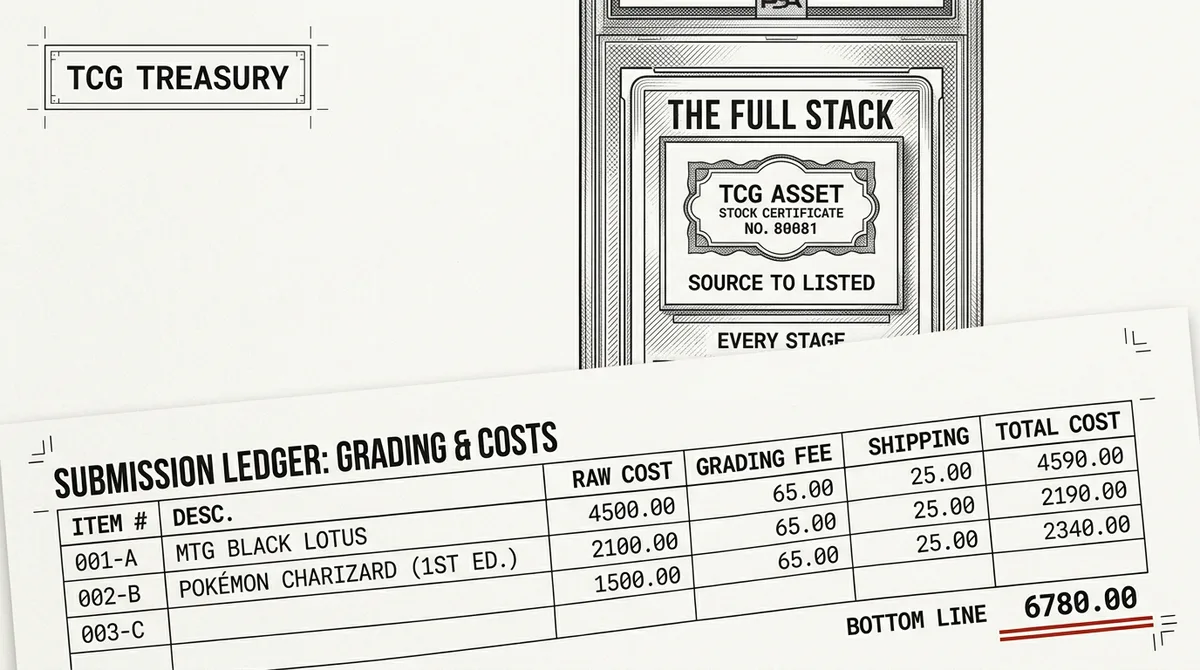
Most people who flip cards lose money not on the cards, but on the minutes. A single raw card might pass through your hands six or seven times — sourcing, comping, deciding whether to grade, identifying the exact variant, pricing it, photographing it, and finally writing a listing. Do that math across a few hundred cards a month and the bottleneck is never your eye for a deal. It's the back office.
This post walks the full stack an operator needs, in the order a card actually moves through your business: sourcing and comps, the grading decision, identification and pricing, listing automation, fulfillment, and bookkeeping. The goal isn't to sell you software at every step — plenty of these stages run fine on a spreadsheet and free public data. The goal is to show you where the time goes, what each tool type is really buying you, and which two or three steps are worth automating first.
If you only fix one thing, fix the middle of the funnel — the identify-price-list stretch where a card sits the longest before it ever earns a dollar. That's where CardDealer lives, and it's the step most dealers underprice in their own heads.
- 01Fix identification and pricing first — at 2–4 minutes per card, it quietly consumes whole days of margin
- 02Buy as if you keep 80 percent of the sale price; fees, processing, and shipping consume the rest
- 03With PSA's cheapest tier now $79.99, a coin-flip between a 9 and 10 is a genuinely risky submission
- 04A flat-fee tool keeps costs predictable; a percentage-of-sales tool punishes your highest-volume months
- 05Reconcile bookkeeping monthly — marketplaces report your gross to the IRS whether you track it or not
Stage 1: Sourcing and comps — know the floor before you buy
Everything downstream is determined by what you pay. Before a card enters your inventory it should already have a number attached: what it sold for recently, not what it's listed for. The two are wildly different, and the gap is where new dealers get burned.
For comps, you want sold-price data, not asking prices. eBay's sold/completed-listings filter is the single most-used free comp source in the hobby, and for good reason — it's the largest pool of real transactions. For sealed product and broad market trends, PriceCharting maintains a long price history that's useful for spotting whether a card is on the way up or quietly bleeding out. TCGplayer's market price is the de facto reference for raw singles in TCGs like Pokemon and Magic. None of these agree perfectly, which is the point: a card's 'value' is a range, and your buy price should sit comfortably under the low end of that range after fees.
The operator move here is to internalize a fee-aware floor. A $40 sold comp is not $40 in your pocket. After marketplace fees, payment processing, and shipping, you typically keep somewhere in the 80-85 percent range depending on the platform — rates vary, so check current rates for whatever you sell on. Buy as if you keep 80 percent and you'll rarely be unpleasantly surprised.
Stage 2: The grading decision — the highest-leverage call you make
Grading is the step with the most money riding on it and the most guesswork baked in — and as of mid-2026, the cost floor has moved significantly. PSA paused its four Value tiers (Value Bulk at $24.99, Value at $32.99, Value Plus at $49.99, and Value Max at $64.99) effective June 2, 2026, after its active backlog hit roughly 10 million cards — a 20 percent submission spike that added about 1.6 million cards in two weeks, approaching the COVID-era peak. The cheapest PSA tier currently accepting submissions is Regular at $79.99 per card with a 40–50 business day turnaround. Above that: Express at $149 (20–30 days), Super Express at $349 (7–10 days), and Walk-Through at $599 (5–7 days). PSA has invested $200 million in infrastructure and is hiring roughly 1,000 additional staff in 2026, and now publishes a monthly Backlog Tracker — but the company estimates it could take up to four months before Value tiers reopen.
TAG, which had been the low-cost AI-grading alternative at around $19 per card, closed its Basic, Standard, and Express tiers at capacity in May 2026 — only its higher-cost Priority and Walkthrough slots remain open, so it is not a viable standard submission option right now. The spillover from PSA's cheap-tier closure pushed collectors toward TAG and CGC simultaneously, filling both. CGC is still accepting cards but runs slow: Bulk is roughly 120 working days, Economy around 65, Standard around 30, with faster lanes available at a premium.
This is a math problem, and the new numbers make it a harder one. The break-even logic is the same as it's always been: (expected graded value × your keep-rate) minus (raw value you're giving up + grading fee + shipping + your time) has to clear comfortably, and you have to weight it by the realistic probability of hitting the grade you're banking on. But with the cheapest realistic submission now at $79.99 and capital locked up for weeks to months, a card that's a coin-flip between a 9 and a 10 is a much riskier bet than it was when bulk tiers were open. The margin for error has shrunk considerably.
This is exactly where a pre-grade read pays for itself more than ever. CardGrade predicts the likely PSA, BGS, or CGC outcome from a photo in about 60 seconds across 47 inspection points, at a stated 92.8 percent accuracy — for a few cents instead of a $79.99-and-up submission. It won't replace the grading company, but it tells you which cards are worth the slab and which should just be sold raw. Wasting $79.99 on a card that grades an 8 is a real and avoidable loss. Pair CardGrade with the break-even calculator at /tools/grading-calculator to put a dollar figure on the decision at current fee levels, and use the grader comparison at /resources/psa-vs-bgs-vs-cgc-vs-tag to understand which companies are actually open and at what cost. The deeper economics live in the grading-ROI pillar at /resources/grading-roi.
Stage 3: Identification and pricing — the silent time sink
Here's the stage almost nobody budgets for honestly. Correctly identifying a card — set, year, number, parallel, the difference between a base and a holo and a numbered refractor — and then pulling a current, defensible price is mind-numbing manual work. A misidentified parallel is a mispriced card, and a mispriced card is either money left on the table or a listing that never sells.
Doing this by hand, a careful dealer might spend two to four minutes per card just on ID and pricing before any photography or writing happens. At a few hundred cards a month that's whole days. This is the part of the workflow that doesn't feel like work — it feels like 'just looking things up' — which is exactly why it quietly eats your margin.
CardDealer collapses this stage: photograph a card and it's identified in about 1.4 seconds, then priced on a three-source blend of PriceCharting, Collectr, and TCGplayer rather than a single feed. A blended price is more honest than any one source because it smooths out the outliers and thin-volume cards that throw off a single reference. The output isn't just a number — it's the structured data that feeds the next step, so identification and pricing stop being two separate manual chores and become one automatic one.
Most people who flip cards lose money not on the cards, but on the minutes
Stage 4: Listing automation — turn data into a published page
Once a card is identified and priced, it still has to become a live listing with a title, condition, photos, and a price on the marketplace where buyers actually are. Written by hand, a good title alone — the keyword-dense, search-optimized kind that surfaces in eBay results — takes real thought, and most dealers either rush it or copy-paste something generic that buries the listing.
This is the payoff stage for the data you've already captured. Because CardDealer already knows exactly what the card is and what it's worth, it generates a publish-ready listing for eBay, Shopify, or TCGplayer — title, details, and price filled in — so the gap between 'card in hand' and 'card for sale' shrinks from minutes to seconds. The pricing model matters here too: CardDealer charges a flat fee and takes 0 percent of your sales, which means the tool's cost is fixed and predictable rather than scaling up exactly as your volume — and your margin pressure — grows. A percentage-of-sales tool punishes your best months. A flat fee doesn't.
For the broader strategy of where and how to list, see the selling pillar at /resources/selling-cards. The tooling just makes sure you're not the bottleneck between a deal and a dollar.
Stage 5: Fulfillment and bookkeeping — the part that compounds
The last two stages are unglamorous and easy to neglect, which is precisely why they separate hobbyists from operators. Fulfillment — shipping supplies, label printing, tracking, and tidy packaging — is mostly a logistics-and-discipline problem. Most marketplaces give you discounted shipping labels in-platform, and a $20 thermal label printer plus a stock of penny sleeves, top loaders, and bubble mailers turns shipping from a daily chore into a five-minute routine. Buy your supplies in bulk; the per-card cost matters more than you'd think once you're moving volume.
Bookkeeping is the stage that quietly decides whether you actually made money. At minimum, track cost basis, sale price, fees, and shipping for every card, because come tax time the difference between guessing and knowing is real dollars — and if you're selling at any volume, marketplaces report your gross to the IRS regardless of what you remember. A dedicated collection-tracker or a disciplined spreadsheet is fine to start; the point is that 'I think I'm profitable' is not a number. Reconcile monthly, not annually.
The through-line across both stages is that they reward systems over heroics. None of it is hard. All of it compounds. For the full operator's view of running this as a business — entity setup, cash flow, scaling — see the card-business pillar at /resources/card-business.
| Workflow stage | What you're really doing | Tool type | Example sources / tools |
|---|---|---|---|
| Sourcing & comps | Setting a fee-aware buy price from sold data | Sold-comp & price-history lookup | eBay sold listings, PriceCharting, TCGplayer market price |
| Grading decision | Deciding raw vs. slab on expected ROI at current fee floors ($79.99+ PSA Regular; Value tiers paused June 2026) | AI pre-grade + break-even math | CardGrade, /tools/grading-calculator |
| Identification | Pinning the exact set, number, and parallel | AI image recognition | CardDealer (about 1.4s per card) |
| Pricing | Pulling a defensible current value | Blended multi-source pricing | CardDealer (PriceCharting + Collectr + TCGplayer) |
| Listing | Turning card data into a live, searchable listing | Listing automation | CardDealer (eBay / Shopify / TCGplayer, flat fee, 0% of sales) |
| Fulfillment | Shipping fast, cheap, and protected | Label printing & supplies | In-platform shipping labels, thermal printer, sleeves/toploaders |
| Bookkeeping | Knowing your real profit and tax basis | Collection tracker / ledger | Dedicated tracker or a disciplined spreadsheet |
List a card in under a minute.
Photograph a card, AI identifies it in 1.4s, prices it on a transparent 3-source blend (PriceCharting · Collectr · TCGplayer), and writes a publish-ready listing for eBay, Shopify, and TCGplayer.
Do I need every tool in this stack to start?
No. The two stages worth automating first are the grading decision and the identify-price-list stretch, because that's where time and money leak fastest. Sourcing comps, fulfillment, and bookkeeping all run fine on free public data and a spreadsheet until your volume justifies more. Add tools when a stage becomes your bottleneck, not before.
Why use a blended price instead of just eBay or TCGplayer?
Any single source has blind spots — thin-volume cards, stale listings, or outlier sales can skew the number badly. Blending several sources (CardDealer uses PriceCharting, Collectr, and TCGplayer) smooths those distortions and gives you a price you can defend to a buyer. For your own gut-check on a big card, it's still worth eyeballing recent eBay sold comps directly.
How does a flat listing fee beat a percentage-of-sales model?
A percentage tool costs you more in exactly your best months — every extra sale is an extra cut. A flat fee, like CardDealer's, is a fixed, predictable line item that your margin grows away from as you scale. At low volume the difference is small; at high volume a percentage model can quietly become one of your largest costs.
Where does pre-grading fit if I'm mostly selling raw cards?
It's more important now than it's ever been. PSA paused all four of its Value tiers effective June 2, 2026, after its backlog hit roughly 10 million cards. The cheapest open PSA submission is now Regular at $79.99 per card — more than three times what the old Value Bulk tier cost. TAG closed its Basic, Standard, and Express tiers at capacity in May 2026, and CGC's slowest lane runs about 120 working days. CardGrade tells you which raw cards are actually worth submitting versus which to sell as-is, in about 60 seconds for cents rather than a multi-week, multi-dollar grading submission. Even a pure raw seller benefits from knowing when a card is a hidden gem-mint worth the slab. Run it through the break-even calculator at /tools/grading-calculator to put a dollar figure on the call at current fee levels.
- eBay — sold/completed listings and seller fees ↗
- PriceCharting — trading card price history ↗
- TCGplayer — market price reference for singles ↗
- PSA — submission updates (Value tiers paused June 2, 2026) ↗
- PSA — service-level update May 2026 ↗
- PSA — backlog tracker ↗
- Sports Collectors Daily — PSA backlog hits 10 million cards ↗
- CGC — grading submission tiers and turnaround times ↗
- Beckett — grading and hobby market reference ↗
- Collectr — collection tracking and pricing data ↗

Jamie Budesky — Founder & Operator
Jamie Budesky is the founder of TCG Treasury and a working card dealer who runs a 10,000-card eBay store. He built CardGrade and CardDealer to solve the grading and selling problems he hits on his own bench every week — so the guides here come from operating a real card business, not theory.
Researched with live market data and current pricing sources, then reviewed against a working card dealer's day-to-day operation.