Reading Population Reports Like a Dealer (and What They Mean for Your Buy)
Pop reports are a pricing tool, not a trivia page. Here is how dealers read scarcity signals, spot trapped supply, and decide whether a grading bet is worth the slab fee.
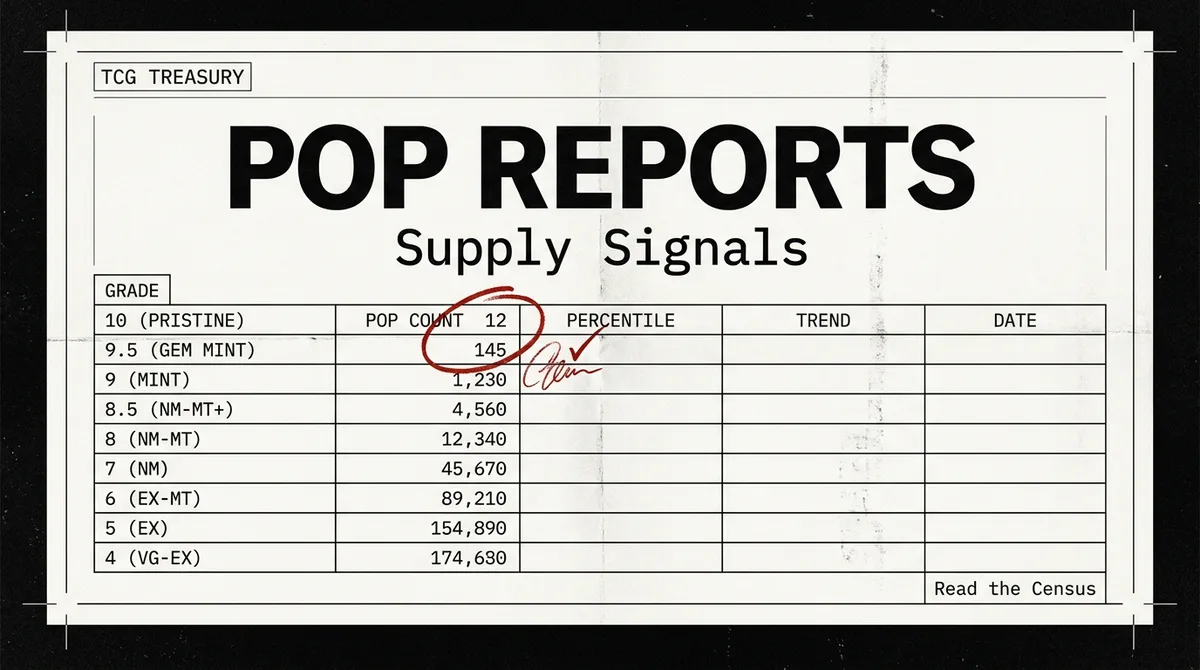
A population report tells you how many copies of a specific card a grading company has slabbed at each grade. PSA, CGC, and BGS all publish them. Most collectors glance at the number, feel something, and move on. Dealers read the same page and price a buy off it.
The difference is that a dealer treats the pop report as a supply curve. A low population at the top grade means the market for clean copies is thin, and thin markets carry premiums. A bloated population means the grade is common, the premium is gone, and you are competing with everyone else's inventory. The number itself is neutral. What you do with it is the edge.
This post is about the money side of pop reports: how to read scarcity, where the data lies to you, and how to decide whether to crack, hold, submit, or pass. It is not a how-grading-works primer. If you need that, start with CardGrade's grading basics and come back. Here we assume you already know what a 9 versus a 10 means and you want to know what it means for your buy.
- 01Cross-grader populations don't share a market — always confirm which grader's census you're reading
- 02Buy the trend, not the screenshot: a pop climbing fast signals borrowed premium, not real scarcity
- 03Condition-rarity pops are durable; submission-rarity pops can collapse the moment volume picks up
- 04With PSA's cheapest open tier at $79.99 per card, predict your grade before submitting — guessing wrong is expensive
- 05Real premiums require both condition rarity and demand; either one alone still leaves you cheap
What a pop report actually measures (and what it doesn't)
A pop report is a running count of every card a grading company has graded and recorded, broken out by grade. PSA, CGC, and BGS each maintain their own, and they only count their own slabs. A card with a PSA population of 12 at grade 10 might have another 40 CGC 10s and 25 BGS 9.5s floating around. The PSA number alone tells you nothing about total supply across the hobby.
That is the first trap. Cross-grader pops do not add up cleanly, and they are not interchangeable in the market. A PSA 10 and a CGC 10 of the same card frequently sell at different prices, so their populations are not one pool. When someone says 'only 12 in a 10,' always ask: in a 10 of whose slab?
The second thing a pop report does not measure is the ungraded population. Every count is cumulative submissions, not total cards that exist. A vintage card with a pop of 300 might have 3,000 raw copies in shoeboxes that nobody has bothered to grade. A modern card with a pop of 5,000 might already have most of its print run slabbed. The report tells you what has been graded, not what could be. For modern cards that gap matters enormously, because the supply that hasn't hit the census yet is the supply that will crush your margin in six months.
Reading scarcity signals like a buyer
The single most useful number is not the total population. It is the count at the grade you are buying, relative to the grades just below it. Dealers look at the shape of the distribution, not one cell.
A healthy scarcity signal looks like a steep drop at the top: lots of 8s and 9s, very few 10s. That steepness is what creates the gem-mint premium. If a card has 2,000 in a 9 and 40 in a 10, the 10 is genuinely hard to get and the price gap between them is defensible. If the same card has 2,000 in a 9 and 1,800 in a 10, the 10 is not scarce at all, the grade is easy to hit, and you should not be paying a steep premium for it.
Then look at the trend, not just the snapshot. Pop reports update constantly, and a low pop today can double in a quarter if the card is being submitted heavily. A pop of 40 in a 10 that was 38 a year ago is real scarcity. A pop of 40 that was 12 six months ago is a card actively being flooded, and today's premium is borrowed against tomorrow's supply. The census is a moving target. Buy the trend, not the screenshot.
How pop reports change your buy/sell math
Here is where it turns into dollars. Worked example, with assumptions labeled so you can swap your own numbers in.
Assume you can buy a raw copy of a card for $60. A graded 9 sells for around $120; a graded 10 sells for around $500. As of mid-2026, the cheapest open PSA tier is Regular at $79.99 per card (40–50 business days), after PSA paused its four Value tiers on June 2, 2026, when the active backlog hit roughly 10 million cards. CGC is accepting submissions but its Bulk lane runs approximately 120 working days. That $79.99 floor — before shipping and your time — changes every piece of the math compared to the sub-$35 bulk tiers that existed a year ago.
On paper the 10 is still a home run. But the pop report says the card sits at 1,500 in a 9 and 1,400 in a 10. That distribution tells you the odds of pulling a 10 are not long, but it also tells you the $500 price is unstable, because 1,400 other 10s exist and more arrive weekly. A common 10 in a heavily-submitted card is a price that erodes. The pop report just turned an obvious buy into a 'sell the raw and move on' decision — and at $79.99 minimum to slab, the cost of being wrong is higher than it has ever been.
Flip it. Same $60 raw cost, but the card sits at 1,500 in a 9 and only 30 in a 10, and that 30 has barely moved in two years. Now the $500 10 is defensible, the premium is real, and the question becomes purely about your odds of hitting the 10 on this specific copy. That is a grading bet worth modeling, and it is exactly what the break-even calculator at /tools/grading-calculator is built for: it takes your raw cost, slab fee, grade-hit probability, and target sale price and tells you whether the expected value clears.
On the sell side, pop reports work in reverse. If you hold a 10 and the population is climbing fast, you are holding a depreciating asset and should sell into current demand before the next wave of submissions lands. If you hold a 10 in a card whose pop has been flat for years, time is on your side.
A low pop today that was half as low six months ago is a card being flooded — today's premium is borrowed against tomorrow's supply
Grading bets on low-pop cards: predict before you submit
The whole low-pop game rewards one skill: knowing what grade your specific copy will get before you pay to find out. That is the entire bet. A pop of 30 in a 10 only matters to you if your card can actually become the 31st. If your copy is a soft-corner 8, the scarcity of the 10 is someone else's opportunity, not yours.
This calculus got sharper in 2026. PSA paused its four Value tiers — Value Bulk ($24.99), Value ($32.99), Value Plus ($49.99), and Value Max ($64.99) — on June 2, 2026, as the backlog surged past 10 million cards. The cheapest open PSA tier is now Regular at $79.99 per card. PSA's Express tier runs $149, Super Express $349, and Walk-Through $599. TAG, which had been positioning itself as an affordable AI-grading alternative, closed its Basic, Standard, and Express tiers at capacity in May 2026; only its Priority and Walkthrough slots remain open. CGC is still accepting submissions, but its Bulk lane is running around 120 working days and its Economy lane around 65. There is no cheap, fast path to a slab right now.
That is the gap between a hopeful submission and a calculated one. The collector sends the card in, pays $79.99 or more, waits weeks or months, and finds out. The dealer assesses the card first, scores it against the grade thresholds, and only submits when the expected grade clears the math the pop report set up. Same card, same pop report, completely different return on capital because one of them knew the odds before spending.
This is where CardGrade fits the workflow. Before you bet on a low-pop 10, photograph the card and get a predicted PSA, BGS, or CGC grade in about 60 seconds, scored across 47 inspection points at 92.8% accuracy. If the prediction comes back a clean 9.5 to 10 on a card where the 10 pop is genuinely thin and stable, that is a submission worth making. If it comes back an 8, you just saved $79.99 or more, the shipping, the months of waiting, and the disappointment. The pop report tells you where the premium is. CardGrade tells you whether your copy can reach it. At current slab costs, you want both pointing the same direction before you spend.
For more on the economics of when grading pays at all, see the grading-ROI pillar at /resources/grading-roi. For which grader to bet on per card, see the comparison at /resources/psa-vs-bgs-vs-cgc-vs-tag, since pop dynamics differ meaningfully across PSA, CGC, BGS, and TAG.
A dealer's pop-report checklist
Before you commit capital to a graded card or a grading submission, run the card through five questions.
One: whose pop is this? Confirm you are reading the right grader's census and not blending populations that don't share a market.
Two: what's the shape? Look at the drop-off from the grade below to the grade you're buying. Steep means scarcity is real; flat means the grade is common.
Three: what's the trend? Is the pop flat over years or climbing this quarter? Flat is durable scarcity; climbing is borrowed premium.
Four: condition rarity or submission rarity? Is the low pop because the card is hard to grade high, or because nobody has submitted it yet? Only the first one holds.
Five: can my copy hit the grade? Predict the grade before you submit. A thin top-grade pop is only an opportunity if your specific card can reach it — and with PSA's cheapest open tier at $79.99 per card and no affordable fast alternatives available right now, the cost of guessing wrong has never been higher.
Get all five pointing the same way and you have a real buy. Miss any of them and you are paying for a number on a page that the next batch of submissions can erase. For the broader playbook on running cards as a business, the parent pillars on selling cards at /resources/selling-cards and building a card business at /resources/card-business connect this back to inventory, margins, and cash flow.
| Signal in the pop report | What it means | Buy/sell decision |
|---|---|---|
| 1,500 in a 9, 1,400 in a 10 | Top grade is common; premium is unstable and erodes as submissions climb | Sell the raw, skip the grading bet — especially at $79.99+ per slab |
| 1,500 in a 9, 30 in a 10 (flat 2 yrs) | Top grade is genuinely scarce and durable; ~$500 premium is defensible | Worth a grading bet if your copy can hit the 10; pre-grade it first |
| Pop 1 at the top, low total submissions | Likely submission rarity, not condition rarity; fragile, can multiply fast | Discount the premium; verify trend before paying up |
| Top-grade pop climbing fast this quarter | Premium is borrowed against incoming supply | If holding a 10, sell into current demand now |
| Steep drop-off below the top grade | Real condition rarity; gem copies are hard to hit | Predict your grade first, then submit if it clears — $79.99 minimum makes accuracy essential |
Predict the grade first.
The grade is the biggest variable in the math. CardGrade predicts your PSA, BGS, and CGC grade from a photo in 60 seconds (92.8% accuracy) — so you only pay to slab the cards that earn it.
Do PSA, CGC, and BGS populations add together for total supply?
No. Each company only counts its own slabs, and a PSA 10 does not sell at the same price as a CGC 10 or a BGS 9.5 of the same card, so they are separate markets, not one pool. When you hear 'only 12 in a 10,' always confirm which grader's census that number comes from. And remember none of them count raw, ungraded copies that could still be submitted.
Is a 'pop 1' card always a good buy?
No. A population of one can mean genuine condition rarity (the card is notoriously hard to grade high) or just submission rarity (almost nobody has sent it in yet). The first is durable; the second can collapse to a pop of eight the moment a few more copies get graded. Check whether the low pop has held across many submissions over time before paying a pop-one premium.
How does a pop report tell me whether to crack and resubmit a card?
Look at the distribution shape and trend at the grade above your current slab. If the higher grade is genuinely scarce and stable, and you believe your card can reach it, the upside may justify the crack and resubmission cost. If the higher grade is common or its pop is climbing fast, the premium is shrinking and cracking is usually a loss. With PSA's cheapest open tier at $79.99 per card as of mid-2026, model the break-even carefully using the calculator at /tools/grading-calculator before you pop the case.
How do I know my card can hit the grade the pop report makes valuable?
Assess the card before you submit instead of after. CardGrade predicts a PSA, BGS, or CGC grade from a photo in about 60 seconds across 47 inspection points at 92.8% accuracy, so you can see whether your specific copy clears the grade where the thin population creates a premium. If the prediction falls short of that grade, the scarcity is someone else's opportunity and you save the slab fee — which now starts at $79.99 for PSA Regular after the Value tiers were paused in June 2026.
What are the cheapest grading options available right now?
As of mid-2026, PSA paused its four Value tiers (Value Bulk through Value Max) on June 2, 2026, with the backlog at roughly 10 million cards. The cheapest open PSA tier is Regular at $79.99 per card with a 40–50 business day turnaround. TAG closed its Basic, Standard, and Express tiers at capacity in May 2026, leaving only Priority and Walkthrough slots open. CGC is still accepting submissions; its Bulk lane runs approximately 120 working days and Economy approximately 65. Check current rates at each grader's site before submitting, as these conditions are actively changing.

Jamie Budesky — Founder & Operator
Jamie Budesky is the founder of TCG Treasury and a working card dealer who runs a 10,000-card eBay store. He built CardGrade and CardDealer to solve the grading and selling problems he hits on his own bench every week — so the guides here come from operating a real card business, not theory.
Researched with live market data and current pricing sources, then reviewed against a working card dealer's day-to-day operation.